
Philodendron Potting Mix & Volume Calculator
Work out how much potting mix your Philodendron pots will need.
Measure the space inside your pot, enter how many containers you are filling, then divide the total between the ingredients in your own mix. The calculator handles common round, square and rectangular tapered pots and can estimate how many bags to buy.
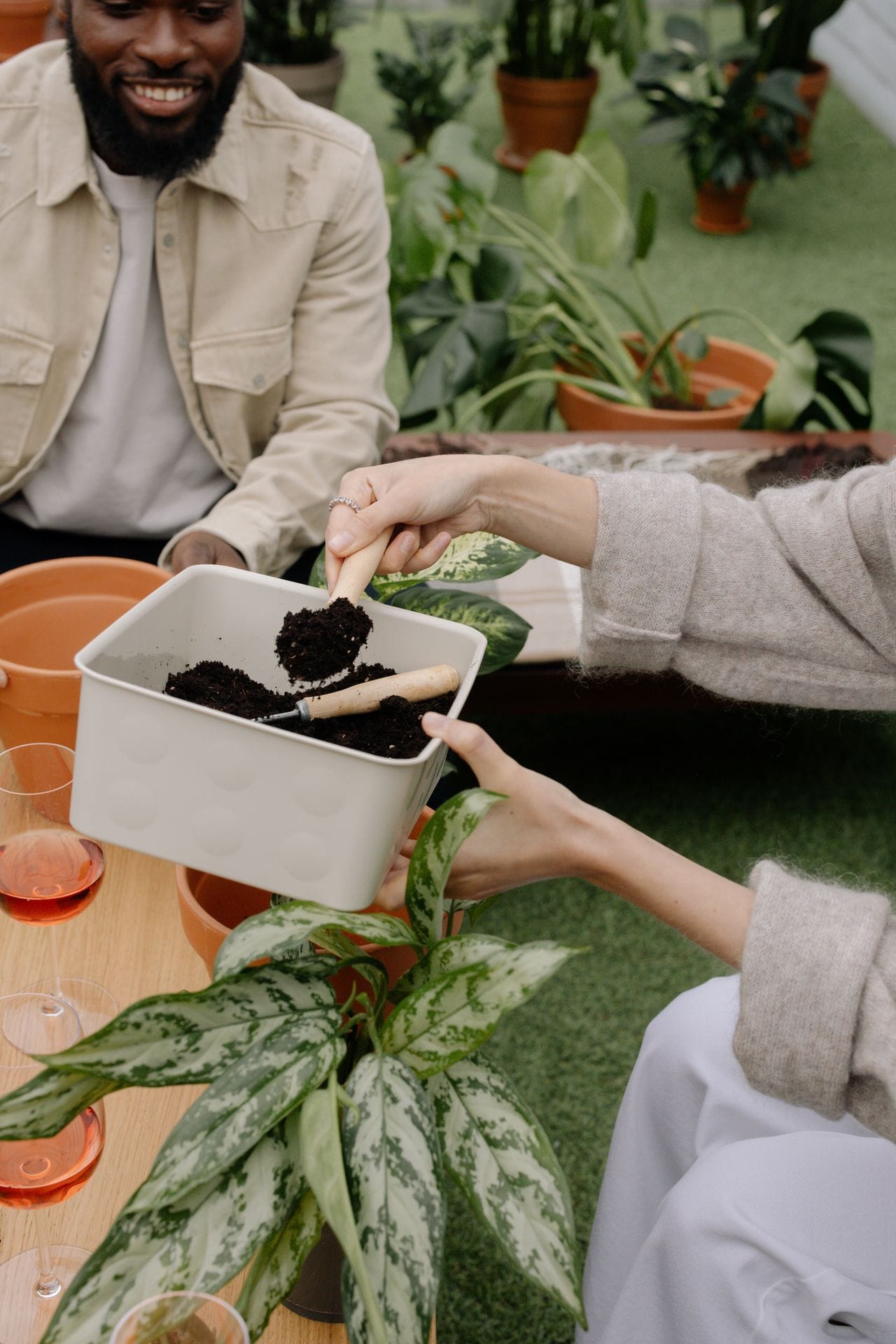
What this tool does: it estimates the empty space inside a measured pot, subtracts any space you enter for an existing root ball, and divides the remaining volume using the ingredient percentages you choose. You can plan one pot or a batch of matching pots, compare units, estimate package counts, and keep your own mix recipes on this device. The result is a batch plan based on the measurements and percentages you enter.
Before you start: gather a few simple tools
You do not need specialist equipment. A few everyday items make the measurements easier and help you mix the amounts accurately.
Use it to measure the inside top, inside bottom and the depth you plan to fill.
Write down the pot measurements, number of pots and any root-ball estimate before entering them.
Choose one marked container so every ingredient is measured by volume in the same way.
A clean tub gives you room to combine the ingredients. Follow the safety advice on each product label.
How to measure each pot shape
Measure the space on the inside of the pot. The calculator estimates how much mix fits below your chosen fill line.
The top measurement is taken across the inside opening. The bottom measurement is taken across the inside floor. The fill depth is the straight up-and-down distance from the inside bottom to the level where you want the mix to stop. It is not always the pot’s full outside height.
⭕ Round or circular pot
Imagine measuring across the centre of a round opening, like measuring the width of a plate.
- Inside top diameter
- Inside bottom diameter
- Vertical fill depth
◻️ Square pot
Measure one inside side from wall to opposite wall. The model assumes the top and bottom are square.
- Inside top side length
- Inside bottom side length
- Vertical fill depth
▱ Rectangular pot
Measure both directions. Keep length and width in the same direction at the top and bottom.
- Inside top length and width
- Inside bottom length and width
- Vertical fill depth
Start-to-finish guide: enter your details in this order
Use this walkthrough beside the calculator below. Each step explains what to enter, what it means and when to leave an optional box at zero.
Choose the pot shape and measurement unit
Select round, square or rectangular. Then select centimetres (cm) or inches (in). Use one unit for every pot dimension. If you change the unit, the calculator converts the measurements already entered. The result display unit is a separate setting later.
Enter the inside measurements
Fill in the top and bottom measurements shown for your chosen shape, then enter the vertical fill depth. If the pot has almost straight sides, the top and bottom measurements may be close. Leave a little room at the top if you want a space for watering.
Count only matching pots together
Enter how many pots have the same shape, measurements, fill depth and occupied-space estimate. If you have three different pot sizes, calculate each size as its own batch. You can add the ingredient amounts from those separate batch sheets afterward when using the same recipe.
Account for space already taken up
This is an optional amount in litres for each pot. Use it only for a root ball or another solid item that will remain inside and take up room where the new mix would otherwise go. The calculator cannot measure the root ball for you. Do not disturb a healthy plant just to fill in this box. Enter 0 for an empty pot or when you do not already have a reasonable estimate; the mix estimate will then be higher rather than relying on a guess.
Enter the recipe you have chosen
Name each ingredient and give it a percentage of the total mix by volume, not by weight. The percentages must add up to exactly 100%. For example, 40 + 25 + 20 + 15 = 100. These are sample numbers to explain the maths, not a recommended Philodendron recipe.
Add bag sizes and an optional extra amount
Enter a package size only when the bag label gives its volume in litres. Do not type a weight in kilograms into a litres box. Choose 0% extra for the calculated amount, or select a reserve for handling or spillage. The extra allowance is optional; it is not a plant-care rule.
Calculate, read, then keep your batch sheet
Press Calculate my mix. Read the three totals first, then check each ingredient line. Copy the batch sheet, download a CSV, or print/save it as a PDF. Save a named recipe on this browser for later, or export a backup before changing devices.
Measure the inside of your pot
Use internal measurements, not the outside of the container. Enter the depth you plan to fill with mix, leaving room at the top for watering.
The calculator script has not connected yet. On the WordPress page, make sure the matching Jefrev JavaScript snippet is active.
⭕ Round pot · top and bottom diameters
◻️ Square pot · side lengths
▱ Rectangular pot · length and width
Build your mix recipe
Enter the ingredients you have chosen and each ingredient’s share by volume. The proportions must add up to 100% before the calculator can make a batch plan.
Your recipe, your proportions. The names and percentages shown are practice values only. They demonstrate how the maths works; they are not a universal or Jefrev-recommended Philodendron mix.
Use at least 2 and no more than 8 ingredients. The percentage shares must add up to 100%.Use the volume printed on the bag, such as 5 L. If the package only shows a weight in kg, leave the bag-size field empty. It cannot be converted to litres without knowing the material density.
Saved recipes are kept in this browser on this device. They are not uploaded to Jefrev. Use Download backup before moving to another browser or device.
Your potting mix quantities
Based on the pot measurements and recipe you entered.
🧪 Ingredient amounts from your recipe
These amounts are the volume to measure for each ingredient. They follow the percentages you entered; the calculator does not check whether the recipe suits a particular Philodendron or growing setup.
📦 Package estimate and shopping check
Use the bag-size estimates as a shopping guide, then check the package label because actual fill volumes and settling can vary.
How to understand the numbers in your result
The calculator shows three main totals. They answer three different questions, so do not treat them as the same number.
The space available for new mix in one pot after the occupied-space amount has been taken away. If the pot is empty and you entered 0, this equals the estimated pot volume.
The mix space per pot multiplied by the number of matching pots. This total is shown before your optional extra allowance is added.
The batch total plus the extra allowance you selected. Ingredient percentages are applied to this final amount.
Worked example: calculate a two-pot batch
Follow these sample numbers to see where each result comes from. This is a maths demonstration only. The ingredient names and percentages below are not a Philodendron care recommendation.
- Find the inside volume of one round pot.
The top radius is half of 18 cm, which is 9 cm. The bottom radius is half of 12 cm, which is 6 cm. Add the three parts inside the brackets: 9 × 9 = 81, 9 × 6 = 54, and 6 × 6 = 36. Their total is 171. Then use π × 16 × 171 ÷ 3 = about 2,865 cubic centimetres. Divide by 1,000 to change cubic centimetres into litres: the pot holds about 2.87 L below that fill line.
- Subtract what is already taking up room.
2.87 L − 0.50 L root ball space = about 2.37 L of new mix for one pot.
- Multiply by the number of matching pots.
The calculator keeps the unrounded value (about 2.365 L) while multiplying: 2.365 L × 2 pots = about 4.73 L for the batch, before extra mix. This is why multiplying the displayed 2.37 L by 2 can differ slightly: the screen rounds for easier reading, but the calculation keeps more digits.
- Add the chosen 10% allowance.
10% of 4.73 L is about 0.47 L. Add it to the batch: 4.73 L + 0.47 L = about 5.20 L to prepare.
- Split the 5.20 L using the recipe percentages.
For each ingredient, multiply 5.20 L by its percentage, written as a fraction. For 40%, use 5.20 × 0.40. The same method is used for each line.
The four ingredient amounts add up to about 5.20 L. The 0.50 L root-ball space is an assumed example value used only to show the subtraction; do not copy it unless it is a fair estimate for your pot. In this package example, each ingredient is sold in a separate 2 L bag, so the calculator would estimate 5 bags in total. On a narrow screen, the package column is hidden from this teaching table to keep it readable; the full package estimate appears in your live calculator results when you enter bag sizes.
🥣 How to measure the ingredients at home
Use a measuring jug or scoop with volume marks, such as a 1 L jug. For this example, 2.08 L means 2 full litres plus about 80 mL; 1.30 L means 1 litre plus 300 mL; 1.04 L means 1 litre plus 40 mL; and 0.78 L means 780 mL. Measure each part separately, then combine them in a clean mixing tub. Use the same scoop and the same loose filling method for every ingredient. Do not pack one ingredient tightly and leave another very loose, because that changes the amount that fits in the scoop.
Why the growing medium still matters after the volume is calculated
The number of litres tells you how much material to prepare, but it does not tell you how that material will behave. Roots need access to water, air and nutrients, and the spaces between particles affect drainage and water storage. Two products with the same bag volume can have different textures and moisture behaviour. Read the ingredient label and use plant-specific guidance when choosing the recipe. The university references below explain these physical properties.
🌿 University and Extension reading
These references support the growing-medium and container guidance on this page. They do not validate a particular recipe entered by a visitor; the calculator’s volume formulas are mathematical estimates based on the dimensions supplied.
Related Jefrev reading: See the plant-specific examples in Philodendron 69686 care and Philodendron Whipple Way care. These examples should not be treated as universal mix formulas.
For readers who want to see the maths: volume formulas and unit changes
Round tapered pot: this shape is called a conical frustum. The calculator uses V = πh(R² + Rr + r²) / 3. Here, R is half the inside top diameter, r is half the inside bottom diameter, and h is the fill depth.
Square tapered pot: first find the top and bottom square areas. If those areas are A and B, the volume is V = h(A + √(A × B) + B) / 3. The model assumes the square sides taper evenly from bottom to top.
Rectangular tapered pot: the length and width are each assumed to change in a straight line from bottom to top. The exact formula used is V = h(2LbWb + LbWt + LtWb + 2LtWt) / 6. Lt and Wt are top length and width; Lb and Wb are bottom length and width.
Convert cubic measurements to litres: when measurements are in centimetres, the result is in cubic centimetres and is divided by 1,000 because 1 litre equals 1,000 cubic centimetres. When measurements are in inches, the cubic-inch result is multiplied by 0.016387064 to convert it to litres.
Finish the batch calculation: subtract occupied space from the gross pot volume for each pot, multiply by the number of matching pots, add the optional percentage allowance, then multiply the preparation total by each ingredient percentage divided by 100. Package counts are rounded up to whole bags.
Important model limit: these equations represent the selected regular shapes with straight, even tapering. They do not calculate curved, bulging, shouldered or irregular walls exactly.
Important limits and safety warning
This tool is a planning calculator, not horticultural testing or a mix recommendation. It is a volume and recipe calculator only. It estimates pot cavity volume from the internal dimensions you provide, subtracts the occupied-space estimate you enter, and splits the remaining amount according to your own percentages. It does not test ingredients, measure air-filled porosity or water-holding capacity, select a recipe for a species, assess root health, identify disease, or guarantee how much material will fit after settling. Its model does not represent rounded, shouldered, ridged or bulging pot walls, and an estimate of root-ball volume may be imprecise. Do not treat the sample recipe as growing advice. Before mixing, check the needs of your plant and the properties and instructions for each material. Do not copy the sample percentages as a care recipe, and do not use garden soil or an ingredient simply because it appears in an example. Use a suitable container with drainage, and follow trusted horticultural guidance for your plant and growing conditions. For unusual pots, use the manufacturer’s capacity or measure the usable space directly where that can be done safely.
Jefrev Potting Mix & Volume Calculator · Educational planning tool. It calculates the proportions you enter; it does not prescribe a growing recipe.