Philodendron Silver Sword Care: What I’ve Learned Growing It Indoors

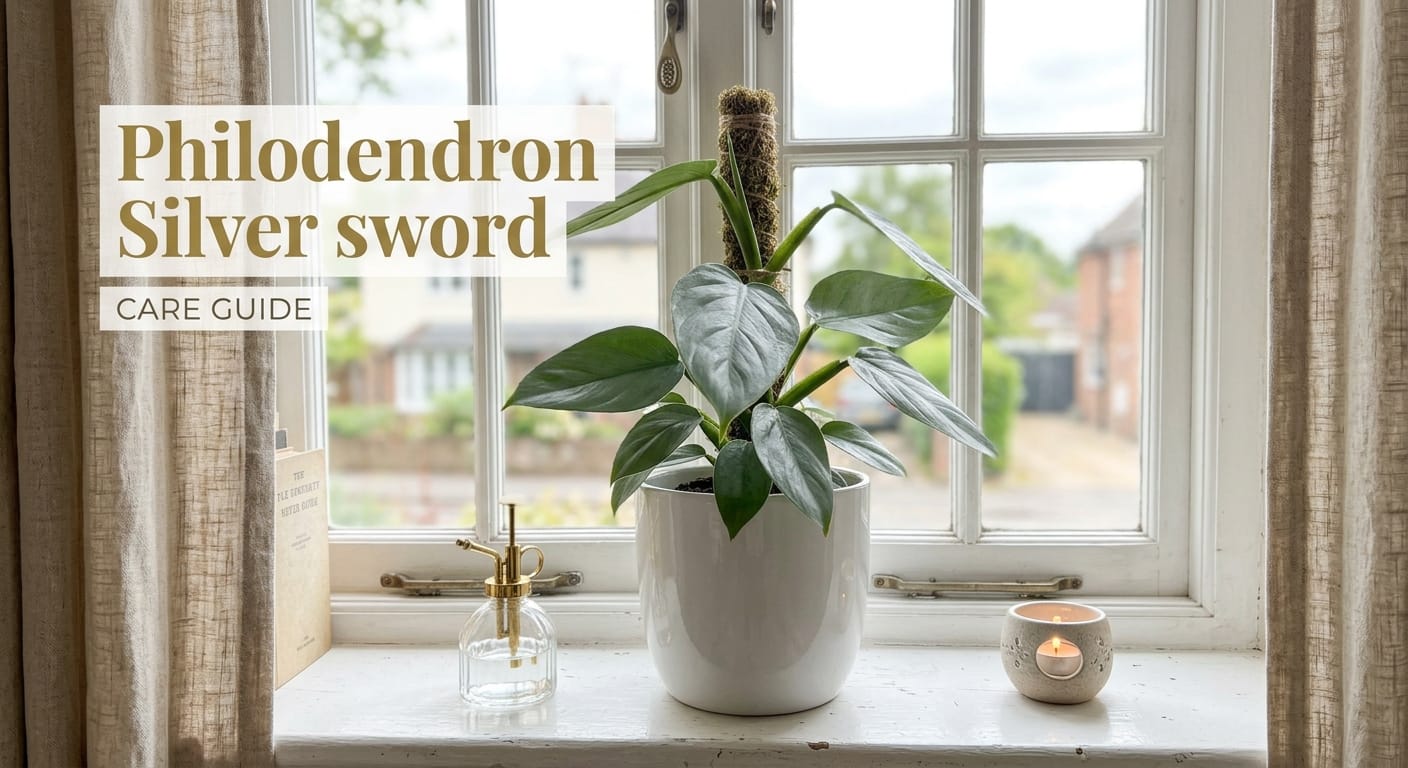
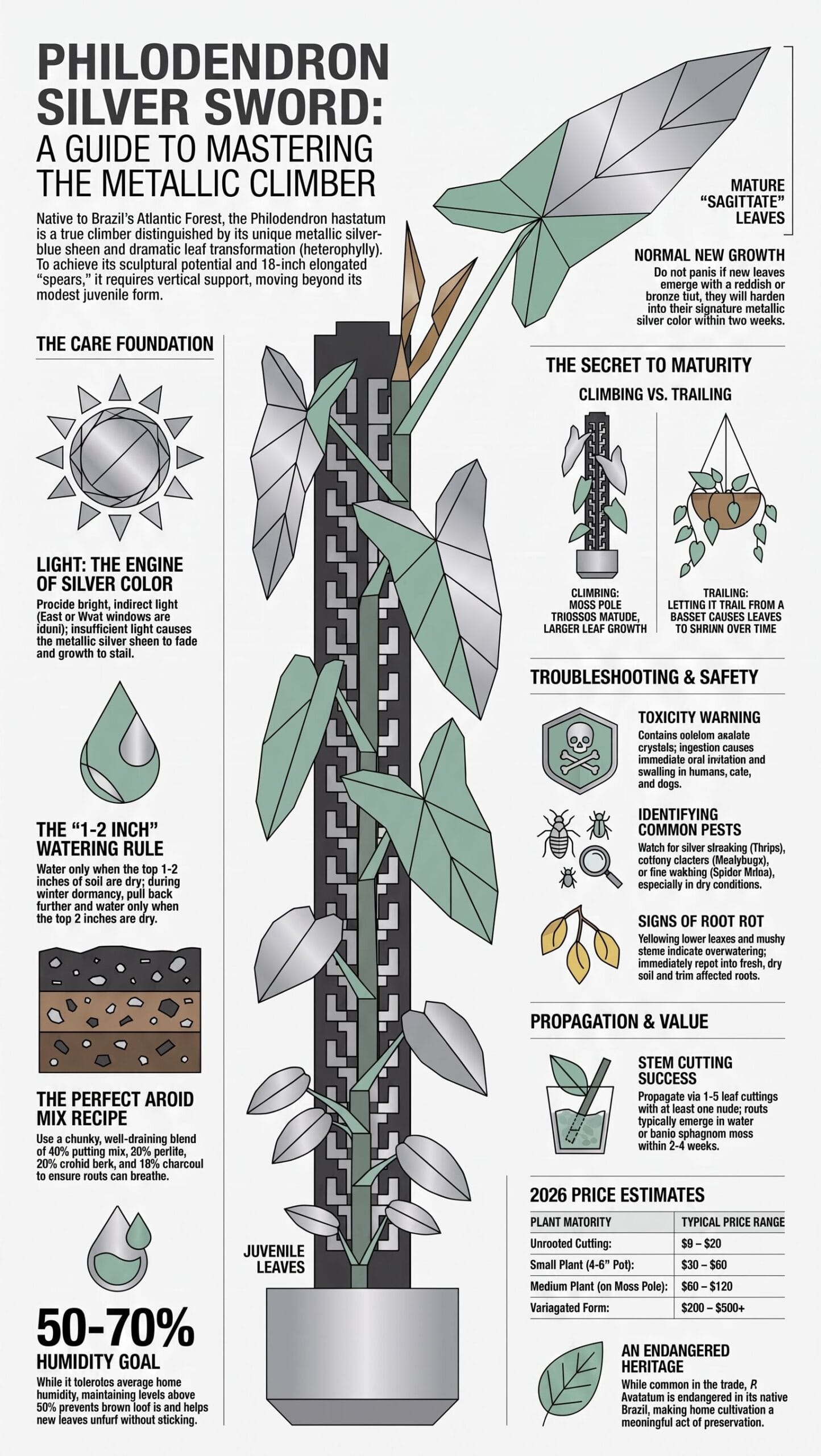
Philodendron silver sword care is simpler than its striking looks suggest. Give it bright indirect light, water only when the top 1-2 inches of soil dry out, and keep humidity above 50%.
Plant it in a well-draining aroid mix. Give it a moss pole to climb, and it will absolutely take off.
But here is the thing most care guides get completely wrong about this plant.
They treat it like any other philodendron. They miss the details that actually matter. Things like why letting this plant trail makes its leaves shrink over time. Or why new growth sometimes comes out reddish before turning silver. Or why a single wrong watering decision in winter can cost you months of progress.
This guide covers all of that. Stick around and you will know exactly what this plant needs, what it hates, and how to keep it thriving year after year.
Key Points at a Glance
| Care Factor | Requirement |
|---|---|
| Scientific Name | Philodendron hastatum |
| Light | Bright indirect; tolerates some morning sun |
| Water | Top 1-2 inches dry between waterings |
| Soil | Chunky, well-draining aroid mix |
| Humidity | 50-70%+ |
| Temperature | 65-85°F (18-27°C) |
| Fertilizer | Balanced NPK, monthly in spring-summer |
| Climbing Support | Moss pole or coir totem strongly recommended |
| Toxicity | Toxic to pets and humans |
| Difficulty | Beginner-friendly |
What is the Philodendron Silver Sword?
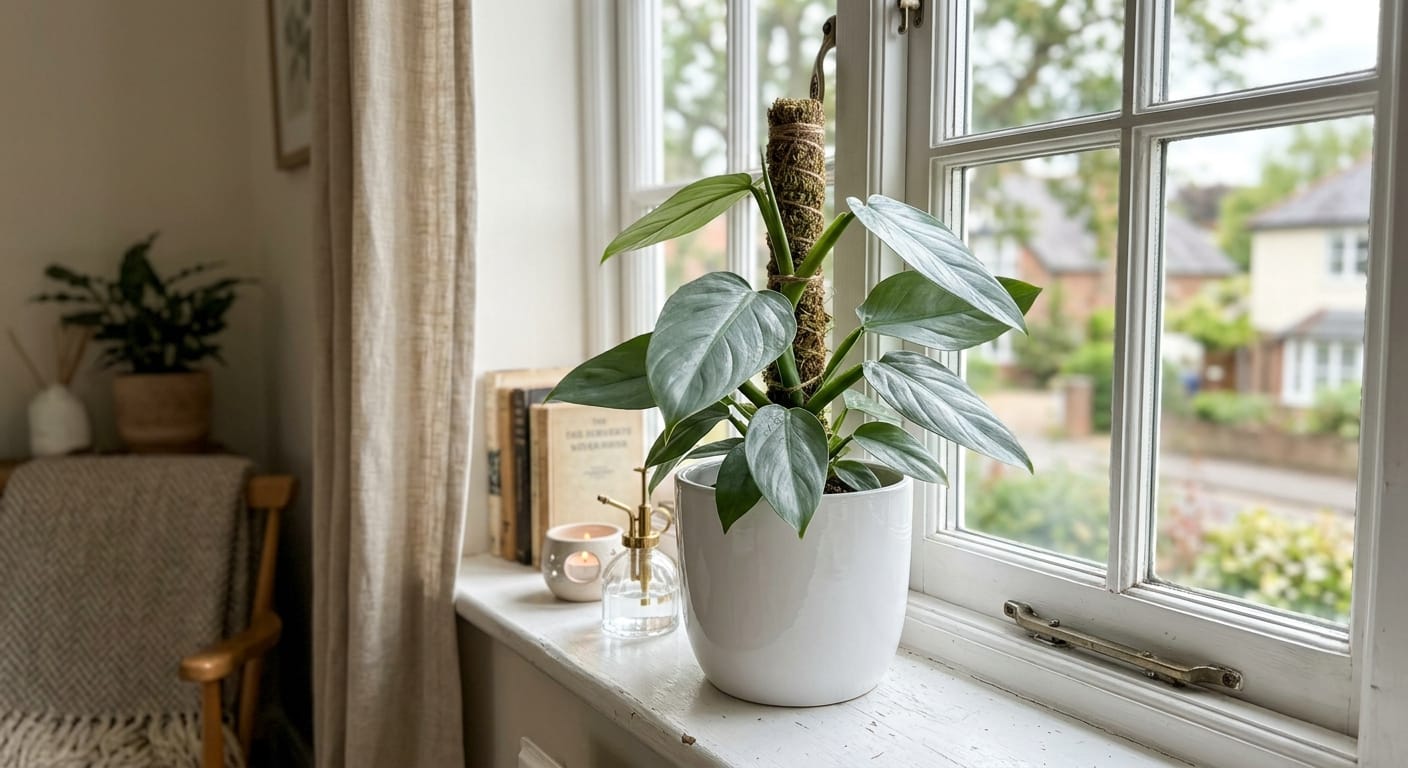
The Philodendron silver sword is a tropical climbing plant. It belongs to the family Araceae. It is one of the most visually distinctive houseplants you can grow indoors.
What makes it stand out? The leaves.
Young plants have smooth, elliptical leaves with a shimmery silver-blue surface. As the plant matures, those leaves transform. They stretch into a long, narrow, spear-like shape with small lobes at the base. The silver metallic sheen intensifies under indirect light. It genuinely looks like hammered pewter on a plant.
This is not a vining plant like a pothos or heartleaf philodendron. It is a true climber. That distinction matters a lot for how you grow it.
It is also an endangered species in the wild, due to habitat destruction in its native Brazil. That makes growing one at home a little more meaningful. You are keeping alive something the world is slowly losing.
Scientific, Botanical, and Common Name
| Name Type | Name |
|---|---|
| Accepted Scientific Name | Philodendron hastatum K.Koch & Sello |
| Family | Araceae |
| Genus | Philodendron |
| Common Names | Silver Sword Philodendron, Silver Sword Philo, Silver Queen Philodendron |
| Old Synonyms | Philodendron domesticum, Philodendron elongatum, Philodendron hastifolium, Philodendron simsii |
A quick heads-up on the name confusion. You will often see this plant sold as Philodendron domesticum or Philodendron Domesticum ‘Silver’. Those names are outdated synonyms. The accepted botanical name today is Philodendron hastatum, confirmed by Plants of the World Online, maintained by the Royal Botanic Gardens, Kew.
The species epithet hastatum comes from the Latin hastatus, meaning “armed with a spear.” That is exactly how the mature leaves look.
The genus name Philodendron comes from the Greek words philo (love) and dendron (tree). So this plant literally translates as “tree lover.” Very fitting, since it spends its life climbing trees in the wild.
Also worth knowing: this plant is part of the second-largest genus in the Araceae family. There are over 600 accepted species of Philodendron as of 2025.
Native Habitat and Origin
The Philodendron silver sword is native to southeastern Brazil. Specifically, it grows in the Atlantic Forest biome. This is one of the most biodiverse and most threatened tropical forest regions on Earth.
In the wild, it grows as an understory epiphyte. It clings to the trunks and branches of large trees. It climbs upward toward gaps in the canopy where filtered light comes through. Rarely does it experience full direct sunlight. The forest canopy shields it from harsh rays.
Here is something striking. This plant is listed as Least Concern on the IUCN Red List globally, but within Brazil specifically, it is considered endangered. Habitat destruction has wiped out large portions of its range. Fortunately, protected reserves in Rio de Janeiro state, including Parque Nacional da Floresta da Tijuca and Reserva Biológica do Tinguá, still harbor wild populations.
The Atlantic Forest has lost more than 80% of its original coverage. Knowing that context gives you a deeper appreciation for what you are growing.
This native environment tells you a lot about what this plant needs at home. High humidity. Warmth. Filtered light. Something to climb. These are not arbitrary care tips. They are direct echoes of where this plant comes from.
Characteristics and Features
Here are the key characteristics of the Philodendron silver sword:
Plant Type: Climbing, herbaceous tropical perennial
Leaf Shape Progression: Young leaves are elliptic and compact. Mature leaves are sagittate (arrowhead-shaped) with pronounced posterior lobes. This change in leaf shape is called heterophylly. It happens as the plant grows upward and matures.
Leaf Color: Metallic silver, silvery-blue, or silvery-green. New leaves often emerge with a slightly reddish or bronze tint. They turn silver as they harden.
Texture: Glossy and smooth. The reflective surface is what gives the plant its signature shine.
Stems: Green to grayish-green. Become thicker and more woody as the plant ages.
Aerial Roots: The plant produces thick, rubbery aerial roots at each node. These roots latch onto climbing surfaces naturally. They absorb moisture from the air too.
Flowers: The plant can produce flowers in the wild. They are typical Araceae-type, with a spadix and spathe structure. They rarely if ever bloom indoors.
Hardiness Zones: USDA Zones 9-11. Can live outdoors year-round in Florida, Hawaii, and Southern California.
Mature Indoor Size: 10-15 feet tall; around 2 feet wide. Outdoor specimens can reach 20-30 feet.
Appearance
You really have to see this plant in person to understand the hype. Photos do not fully capture it.
The leaves have a metallic, almost iridescent quality. Under natural light, they shift between silver, seafoam green, and blue-grey depending on the angle. They are smooth and slightly waxy to the touch.
Young plants look almost modest. The leaves are smaller, more oval, and a softer shade of silver-green. Some people mistake them for similar-looking plants at first glance.
Then the plant matures. Leaf size increases significantly. Shape shifts from oval to a bold, elongated arrowhead with two distinct lobes at the base. In optimal conditions, mature leaves can reach 18 inches wide. They become bold and sculptural. This is a plant that completely transforms as it ages.
The stems are sturdy and upright. Unlike vining philodendrons, the silver sword grows mostly upward. Not outward or trailing.
One thing that catches first-time owners off guard: the new growth emerges looking slightly brownish-red or bronze. This is completely normal. Let it unfurl on its own. Do not pull or peel the sheath. The silver color develops fully within a week or two.
Growth Pattern
The Philodendron silver sword is a climber, not a viner. That distinction is important.
Vining plants like pothos trail passively from pots. They let gravity do the work. They grow long, cascading stems.
The silver sword does the opposite. It naturally wants to grow upward. In the wild, it attaches its aerial roots to tree bark and climbs toward the canopy. Without something to climb indoors, it will grow upward awkwardly. It may lean, topple, or produce increasingly smaller leaves over time.
When it has a moss pole to grip, the growth pattern changes completely. The plant stands tall and proud. Internodal spacing tightens. New leaves come out larger and more mature-looking. This is the most important setup decision you can make for this plant.
Growth speed is moderate to fast during spring and summer. A healthy plant in good light can push out a new leaf every 2-4 weeks. Some growers report faster growth.
User @TheFernFae on Greg.app noted: “My silver sword only grows rapidly under really good lighting. I have her next to my window and she has a new baby every other week.” (Source: Greg.app community discussion)
In lower light, growth slows noticeably. Plants in poor light also produce smaller leaves. The silver coloration can become less vivid. The plant just looks a little washed out.
A note on trailing. Some growers let silver swords trail from hanging baskets. This can look nice temporarily. Over time though, leaves get progressively smaller. The plant needs upward movement to trigger mature growth. If you love the look of trailing, just know the leaf size will shrink.
Dormancy
The Philodendron silver sword does not follow a strict dormancy period the way deciduous plants do.
But it does slow down significantly in fall and winter. This is especially true in northern states with lower light levels and shorter days. Growth may nearly stop from November through February.
During this period, the plant is resting, not dying. Do not try to force growth by fertilizing. Do not overwater out of worry. These are two of the most common winter mistakes.
What to do instead: pull back watering. Water only when the top 2 inches of soil are dry instead of 1 inch. Skip fertilizer entirely until spring. If you have grow lights, running them for a few extra hours can help maintain some growth momentum.
Temperature drops below 55°F stress this plant significantly. Keep it away from drafty windows and exterior walls in winter. Cold drafts are a genuine threat in northern US homes during these months.
Benefits of Growing Philodendron Silver Sword
Air Quality. The silver sword, like many philodendrons, can help filter indoor air. NC State Extension notes that the plant has ornamental value and helps improve air quality by filtering certain toxins. While the extent of this benefit in a typical home setting is modest, every bit helps.
Aesthetic Impact. This plant is genuinely stunning. The metallic silver foliage adds a sculptural, architectural element to any space. It works beautifully in modern, minimalist, and tropical-style interiors.
Biophilic Benefits. Growing plants indoors is consistently linked to reduced stress, improved mood, and better focus. Having living plants that you actively care for can be genuinely grounding.
Ease of Care. Despite its exotic appearance, this plant is forgiving and beginner-accessible. Even if you make a few early mistakes, it tends to bounce back. That resilience makes it a confidence-builder for new plant parents.
Propagation Potential. Once you have one healthy plant, you can multiply it easily. That means you can share cuttings with friends, grow a collection, or sell/trade plants in local communities.
Conversation Starter. Honestly? This plant makes people stop and ask what it is. Very few houseplants have leaves that naturally look metallic.
Philodendron Silver Sword Care Guide
Sunlight
The silver sword needs bright, indirect light. That is the foundation of everything else.
In its native rainforest, it lives under the tree canopy. It gets dappled, filtered light most of the day. Sometimes it catches direct sun through gaps in the canopy. But never harsh, all-day direct sun.
Indoors, recreate this by placing the plant close to a window with filtered light. An east-facing window is ideal. It gets gentle morning sun and bright indirect light the rest of the day. A west-facing window works well too, with softer afternoon sun.
If you have a south-facing window, that works, but put the plant 3-4 feet back from the glass. Or diffuse the light with a sheer curtain. South windows in the US can deliver intense midday sun that scorches the leaves.
North-facing windows are the most challenging. The plant can survive there. But it will grow slowly. Leaves will be smaller. The silver coloration may fade slightly.
A useful observation from Raffaele Di Lallo at Ohio Tropics: “Indoors, there is much less light than we think. You can safely give your Silver Sword some direct sun.” (Source: OhioTropics.com)
If growth has stalled and the plant looks leggy, it almost certainly needs more light. Move it closer to the window. Or add a grow light set to run 12-14 hours per day.
Signs of too much light: brown, crispy patches on leaves; leaf edges scorching. Signs of too little light: slow growth, small pale leaves, less silver coloration.
Watering
Watering is where most people get into trouble with this plant. Both overwatering and underwatering hurt it. But overwatering is the bigger danger.
The right approach: let the top 1-2 inches of soil dry out between waterings. Then water thoroughly. Water until it runs freely from the drainage holes. Empty the saucer after 30 minutes. Never let the pot sit in standing water.
In spring and summer, you will probably water every 7-10 days. In fall and winter, every 12-14 days is more typical. These are rough guides. Always let the soil tell you when to water, not the calendar.
Get a simple moisture meter if you are new to this. They cost about $10 and remove all the guesswork.
One user review on Greg.app described their experience with this plant: “Very beautiful, big leaves. Grows very quickly, especially when it’s little. Easy to care for and not labour intensive. Only downside, not really a downside, just a note really. Leaves brown very easily.” (Source: Greg.app)
That leaf-browning comment is real. Inconsistent watering is usually the cause. Both letting it get bone dry and keeping it too wet will cause brown edges or tips.
If you water from the top, pour slowly and evenly around the base. Avoid getting water directly on the leaves. If water collects in the joints where leaves meet the stem, wipe it away. Sitting moisture there can encourage rot.
Tap water is generally fine. If your tap water is heavily chlorinated, let it sit overnight in an open container before using. Or collect and use rainwater, which this plant particularly likes.
Signs of overwatering: mushy stems, yellow leaves, soggy soil that stays wet for weeks, root rot smell. Signs of underwatering: drooping leaves, dry crispy edges, bone-dry soil pulling away from pot edges.
Fertilizer
This plant is a moderate feeder. It benefits from regular fertilization during its active growing season. It does not need heavy feeding.
Use a balanced, water-soluble fertilizer with equal or near-equal NPK ratios. Something like 10-10-10 or 20-20-20 works well. Apply at half the recommended strength. Fertilize once a month from March through September.
Do not fertilize in fall or winter. The plant is resting. It cannot use extra nutrients. Fertilizing during dormancy leads to salt buildup in the soil. This burns roots over time.
A few notes worth knowing. Liquid fertilizers work faster but flush out quickly. Slow-release granular fertilizers offer steady, low-level feeding over months. Both work. If you tend to forget monthly feeding, go with slow-release.
Occasionally flush the soil thoroughly with plain water. Do this every 2-3 months. It helps wash out accumulated mineral salts. You will see whitish crust form on the soil surface or pot rim if salts are building up.
If the plant is producing smaller leaves despite good light, a small fertilizer boost in spring can help. If leaf edges turn brown shortly after fertilizing, you may be feeding too much or too strong.
Avoid high-phosphorus fertilizers intended for flowering plants. This plant does not need phosphorus emphasis. Stick to a balanced formula.
Soil Mix
The silver sword needs a chunky, airy, well-draining soil mix. Standard potting soil from the bag is usually too dense on its own.
A good DIY aroid mix:
- 40% standard potting mix (something like Fox Farm Happy Frog or Espoma Organic Potting Mix)
- 30% perlite (for drainage and aeration)
- 20% orchid bark or pine bark fines (for structure and air pockets)
- 10% horticultural charcoal (optional but helpful for preventing bacterial buildup)
This creates a mix that holds enough moisture to hydrate roots without staying soggy. Water moves through it quickly. Roots can breathe.
Soil pH should sit between 5.5 and 7.0 (mildly acidic to neutral). Most bagged potting mixes already fall in this range. You do not need to adjust pH unless you are having persistent nutrient deficiency issues.
Do not use garden soil. It compacts badly in containers. It drains poorly. It can introduce pests and pathogens.
If you want a pre-made option, look for mixes labeled “aroid mix” on Etsy or Amazon. Several small sellers blend quality mixes that work very well for this plant. Check reviews carefully before ordering.
The pot itself matters too. Terra cotta pots dry out faster, which reduces overwatering risk. Plastic pots retain moisture longer. Choose based on your watering habits. If you water frequently, go terra cotta. If you often forget, plastic buys you more time.
Humidity
The silver sword comes from a tropical rainforest. It loves humidity. Most homes sit between 30-50% relative humidity. That is on the lower end for this plant, but it can manage.
Ideal humidity range: 60-70%. The plant will grow faster, produce larger leaves, and look generally healthier at these levels.
Ways to boost humidity:
- Humidifier: The most effective solution. A small ultrasonic humidifier placed near the plant makes a real difference. Run it a few hours a day.
- Pebble tray: Fill a shallow tray with pebbles and water. Set the pot on top. As water evaporates, it raises local humidity slightly. Modest effect but better than nothing.
- Grouping plants: Clustering plants together creates a slightly more humid microclimate. Each plant releases moisture through transpiration.
- Bathroom placement: If your bathroom gets good light, it is a naturally humid environment. Many growers keep moisture-loving tropicals there.
Misting is sometimes suggested but rarely effective. The benefit lasts only minutes. And misting leaves that do not dry quickly can encourage fungal issues. Skip misting unless you are just enjoying the ritual.
During winter in northern states, indoor heating systems dry out the air significantly. Humidity can drop to 20-30%. A humidifier is almost essential in those conditions. The plant will show stress through brown leaf tips and edges when humidity drops too low.
Temperature
This plant likes warmth. Keep it between 65°F and 85°F (18-27°C) year-round.
It can briefly tolerate temperatures down to about 55°F. Sustained cold below that range causes cellular damage. Leaves may turn dark or mushy. The plant will decline.
Never let it sit near an air conditioning vent. Cold blasts of dry air stress the plant quickly. The same applies to heating vents, which dry out the air. Keep the plant away from both.
Windows in northern states can get cold enough in winter to chill the leaves of plants sitting right against the glass. Move plants a few inches back from the window pane during cold snaps.
Outdoor growers in USDA Zones 9-11 can leave this plant outside year-round. In Zone 8, it may survive mild winters but bring it in when frost is predicted.
If you summer your plants outside (a great practice for boosting growth), bring the silver sword back inside before nighttime temps drop below 60°F. In most of the US, that means coming in by early October.
Climbing Stake
This is not optional. It is one of the most important care decisions you will make for this plant.
The silver sword is a climber. Without a support to climb, it grows awkwardly. It leans. The leaves stay small and juvenile-looking. Giving it a moss pole transforms the plant.
When aerial roots grip a moss pole, the plant behaves more like it does in the wild. It grows upward with purpose. Internodal spacing shortens. New leaves emerge larger and more mature-looking, with the characteristic arrowhead shape and dramatic lobes.
Types of climbing supports:
- Sphagnum moss pole: The gold standard. Aerial roots can actually penetrate and grip the moist moss. Keep the pole consistently damp. Spray it down when you water the plant.
- Coconut coir totem: Similar to a moss pole. Slightly less moisture-retentive. Still works well.
- Bamboo stake or wooden dowel: Works for guiding upward growth. But aerial roots cannot really grip it. Less effective for triggering mature leaf growth.
- Wooden plank or cedar board: Some growers use rough-textured wood planks. Roots can grip these well.
When setting up the pole, introduce it before the plant gets large. Pushing a pole into an established root ball later can damage roots. Start early.
Secure the stems to the pole loosely with soft plant ties or strips of pantyhose. Do not tie tightly. You want to guide, not constrict.
As the plant grows and aerial roots attach on their own, you can remove the ties. The plant will support itself.
Toxicity
This is important to know before you bring a Philodendron silver sword into a home with pets or small children.
All philodendrons contain calcium oxalate crystals. These are microscopic, needle-like structures found in the plant’s sap and tissues. When chewed or ingested, they cause immediate and intense irritation to the mouth, tongue, and throat. Swallowing can cause difficulty breathing, drooling, vomiting, and swelling.
The ASPCA lists philodendrons as toxic to cats and dogs. Symptoms of ingestion in pets include oral irritation, excessive drooling, pawing at the mouth, vomiting, and difficulty swallowing. If you suspect your pet ingested any part of this plant, contact your vet or the ASPCA Poison Control hotline.
For humans, casual handling is completely safe. The calcium oxalate crystals do not penetrate unbroken skin. However, wear gloves when pruning or propagating. Wash hands thoroughly afterward. Avoid touching your eyes or mouth during plant handling.
Keep this plant out of reach of climbing cats and curious toddlers. Hang it high, place it on a tall shelf, or use a room your pets do not access.
Repotting Guide
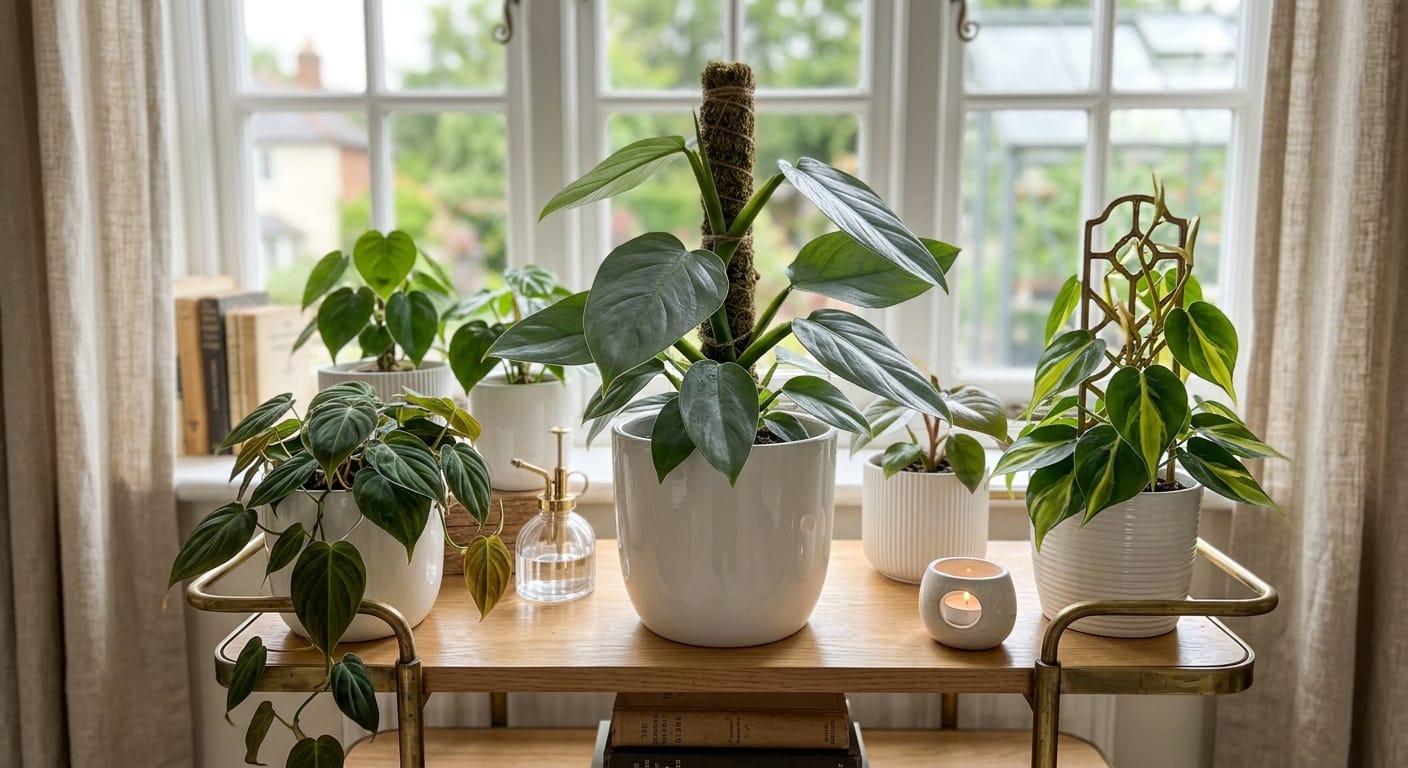
The silver sword likes to be slightly snug in its pot. It does not need frequent repotting.
When to repot: Every 1-2 years is typical. Or when you see roots circling the bottom of the pot, coming out of drainage holes, or the plant drying out unusually fast after watering.
Pot size: Go up just one pot size at a time. That means increasing the diameter by 1-2 inches. Going too large creates a lot of excess soil. Excess soil stays wet too long. That raises root rot risk significantly.
Best time to repot: Spring, when the plant is entering active growth. Repotting during fall or winter is harder on the plant. It has less energy to recover and establish new roots.
How to repot:
- Water the plant the day before. Moist soil holds together better. It also reduces transplant stress.
- Gently ease the plant out of its current pot. Tip it sideways if needed. Do not pull by the stem.
- Shake off some old soil. Inspect the roots. Healthy roots are white to light tan. Soft, dark, or mushy roots are rotting. Trim any rotten roots with clean, sharp scissors. Dust cuts with cinnamon or activated charcoal to discourage further rot.
- Add a layer of fresh aroid mix to the new pot. Place the plant. Fill in around the sides. Press lightly to remove air pockets.
- Water thoroughly. Let excess drain.
- Keep the plant out of direct sun for 1-2 weeks after repotting. It is recovering.
Do not fertilize for 4-6 weeks after repotting. Fresh potting mix has nutrients. Give the plant time to settle before adding more.
Pruning Guide
The silver sword does not need heavy pruning. But occasional trimming helps it look better and grow healthier.
What to prune:
- Yellow or brown leaves: These will not recover. Remove them at the base of the stem. Use clean, sharp scissors or pruning shears. This redirects the plant’s energy to healthy growth.
- Leggy stems: If a stem has grown long with widely spaced leaves and looks sparse, you can cut it back. Cut just above a node (the joint where a leaf attaches). The plant will push out new growth below the cut.
- Damaged or pest-affected leaves: Remove these promptly to prevent spread.
Pruning for shape: If you want a bushier plant instead of a tall climber, pinch or cut the growing tip. This encourages the plant to push out side shoots. Not all silver swords will respond this way. Some push new growth from the base instead. But it is worth trying.
When to prune: Any time of year is technically fine. But spring is ideal. The plant has maximum energy to regrow.
Always use clean tools. Wipe blades with rubbing alcohol between cuts. This prevents spreading any potential pathogens from one plant to another.
Do not remove healthy leaves just to tidy the plant up. Leaves are how plants photosynthesize and power their growth. Each healthy leaf is doing something useful.
Propagation Guide
Propagating the Philodendron silver sword is genuinely one of the more satisfying things you can do with this plant. It is not difficult. Success rates are high with the right technique.
Method 1: Stem Cuttings in Water
This is the easiest and most commonly used method.
- Choose a healthy stem with at least 1-2 leaves and one visible node. The node is the bump or joint where a leaf attaches. This is where roots will grow from.
- Use clean, sharp scissors or pruning shears. Cut just below a node.
- Remove any leaves that would be submerged in water.
- Place the cutting in a clear glass or jar of water. Submerge only the node. Keep the leaves above water.
- Place the jar in bright, indirect light. Change the water every 5-7 days to keep it oxygenated and clear.
- Roots typically emerge within 2-4 weeks.
- Once roots are 1-2 inches long, pot the cutting up in fresh aroid mix. Keep the soil consistently moist for the first 2 weeks as the plant transitions to soil roots.
Method 2: Stem Cuttings in Sphagnum Moss
This produces soil-ready roots faster than water.
- Take the same type of cutting as above.
- Let the cut end callous for 30-60 minutes.
- Wrap the node in damp sphagnum moss. Secure it with plastic wrap or place the whole setup in a ziplock bag to maintain humidity.
- Keep in bright, indirect light at 70-80°F.
- Check weekly. Roots typically form within 2-3 weeks.
- Once roots are established, pot up in fresh soil.
Method 3: Air Layering
This is the most advanced method but produces the most stress-free results.
- Identify a healthy stem with a visible node.
- Make a small, shallow wound in the stem just below the node. Do not cut through the stem.
- Apply rooting hormone to the wound.
- Wrap the wounded area in a handful of damp sphagnum moss.
- Cover with clear plastic wrap and seal at both ends with tape.
- In 3-6 weeks, you will see roots growing through the moss.
- Once roots are well-developed, cut the stem below the moss ball. Pot up the cutting with the moss still attached.
Tips for Better Propagation Success
- Use rooting hormone powder or gel on cuttings for faster root development.
- Maintain warm temperatures above 70°F during rooting.
- Keep humidity high around cuttings. A clear plastic bag over a water-propagation setup helps a lot.
- Do not rush the transition from water to soil. Wait for roots of at least an inch.
- The mother plant will push out new growth from the cut site. Do not panic if it looks bare for a while.
Common Pests and Disease Problems
Spider Mites
Signs: Fine webbing under leaves. Tiny moving dots visible with magnification. Leaves may look faded, stippled, or silvery.
Why they appear: Low humidity, dusty conditions, stressed plants. Spider mites love dry, hot environments.
Treatment: Immediately isolate the affected plant. Wipe leaves top and bottom with a damp cloth. Follow up with neem oil spray or insecticidal soap. Spray every 5-7 days for 3 weeks. Boost humidity afterward. Spider mites hate moisture.
Mealybugs
Signs: White, cottony clusters in leaf joints, on stems, and along leaf undersides. Sticky residue (honeydew) on leaves.
Treatment: Dab individual bugs with a cotton swab dipped in 70% isopropyl alcohol. Spray the whole plant with neem oil solution or insecticidal soap. Repeat weekly for a month. Check nearby plants carefully.
Aphids
Signs: Small green, black, or yellow insects clustered on new growth. Sticky honeydew on leaves. Distorted or curling new growth.
Treatment: Blast the plant with a strong stream of water to dislodge them. Follow up with neem oil spray or insecticidal soap. Repeat weekly until clear.
Thrips (Banded Greenhouse Thrips)
NC State Extension specifically lists banded greenhouse thrips as a known pest of Philodendron hastatum. These are tiny, fast-moving insects that scrape plant tissue and feed on sap.
Signs: Silver streaking or stippling on leaves. Black fecal dots on leaf surfaces. Distorted growth.
Treatment: Sticky yellow traps for monitoring. Spinosad spray or neem oil for active infestations. Repeat every 5-7 days for 3-4 applications.
Scale
Signs: Small, brown, waxy bumps stuck to stems and leaf undersides. Hard to remove by hand.
Treatment: Scrape off manually with a toothbrush or cotton swab dipped in alcohol. Follow with neem oil or systemic insecticide for severe infestations.
Root Rot
Cause: Overwatering. Soil that stays wet too long. Poor drainage. Cold temperatures combined with wet soil.
Signs: Yellowing leaves. Mushy, darkening stems at the base. Foul smell from soil. Plant appears to be wilting despite wet soil.
Treatment: Remove the plant from its pot immediately. Shake off all old soil. Trim all black, mushy, or soft roots back to healthy white tissue. Dust cuts with cinnamon. Let roots air out for a few hours. Repot in fresh, well-draining soil in a clean pot with drainage holes. Hold off watering for a few days. Let the plant stabilize.
Prevention is far better than treatment. Root rot is usually fatal if caught late.
Leaf Spot (Bacterial or Fungal)
Signs: Dark brown or black spots with yellow halos on leaves. Often starts as small spots that spread if unchecked.
Cause: Water sitting on leaves, poor air circulation, high humidity without airflow.
Treatment: Remove affected leaves. Improve airflow. Water from the base rather than top. Apply a copper-based fungicide for fungal issues. Improve spacing between plants.
Pricing Guide
Pricing for the Philodendron silver sword varies based on plant size, seller, and where you are in the US. Here is a general breakdown as of 2026.
| Plant Size | Typical Price Range |
|---|---|
| Cutting (unrooted) | $8-$20 |
| Rooted cutting / baby plant (2-4″ pot) | $15-$35 |
| Small plant (4-6″ pot) | $30-$60 |
| Medium plant (6-8″ pot on pole) | $60-$120 |
| Large mature plant (8″+ pot) | $120-$250+ |
| Variegated form (P. hastatum variegatum) | $200-$600+ |
Prices fluctuate. During the height of the houseplant boom in 2020-2022, silver swords sold for much more. The market has since settled. You can sometimes find starter plants at Home Depot or Lowe’s for $25-$45 in a 4″ pot.
The variegated form is a different story entirely. It is genuinely rare. Supply is extremely limited. Pricing can go high on the collector market. Verify any variegated plant carefully before paying premium prices.
Buying Guide
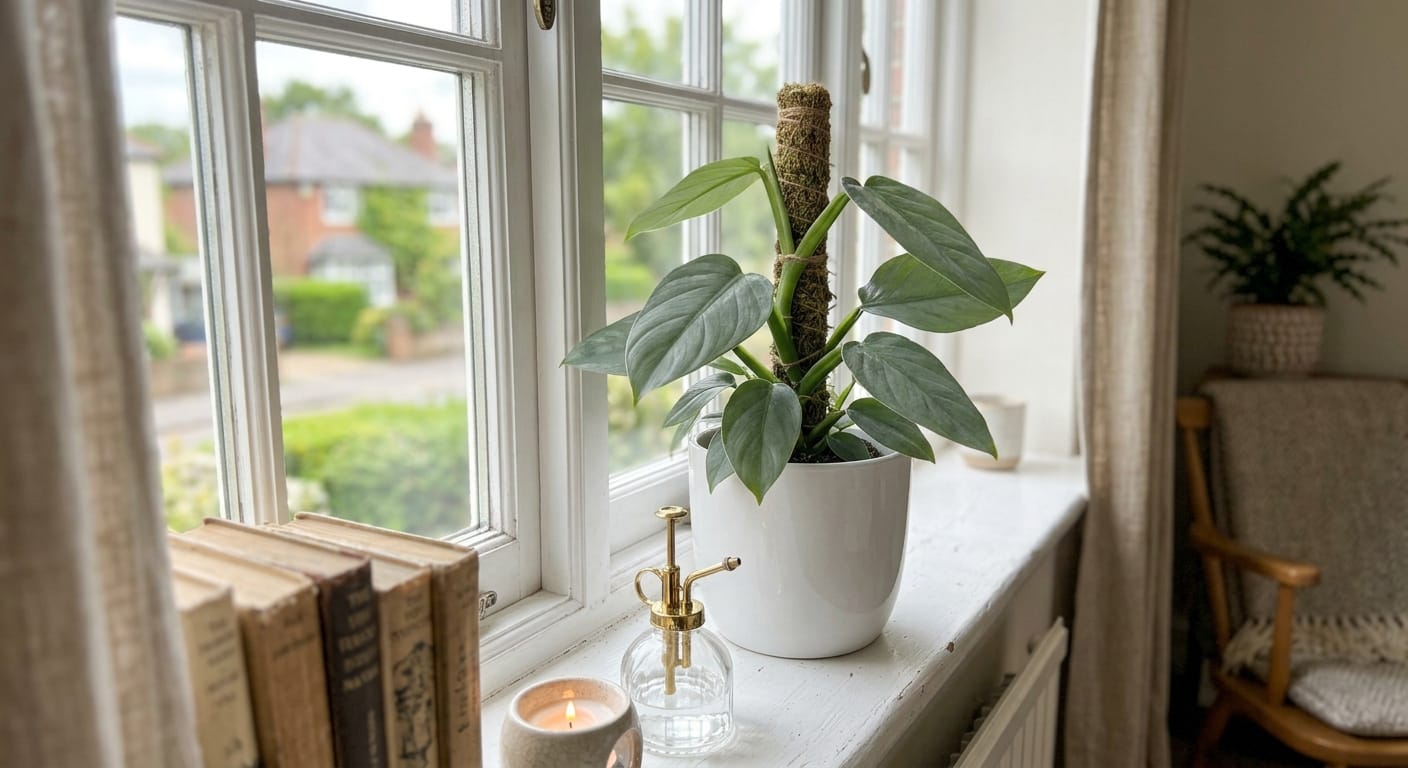
Where to Buy
Local nurseries and garden centers. Always the best first choice. You can inspect the plant before buying. Check for pests. Assess health. Look for roots coming from drainage holes, which signals a root-bound plant that needs repotting.
Home Depot / Lowe’s. Both occasionally stock silver swords. Prices are usually competitive. Quality varies. Inspect carefully for pests and root health before buying.
Etsy. A massive marketplace for plant sellers. Many small specialist growers sell quality plants and cuttings here. Read reviews carefully. Look for sellers with good shipping feedback. Ask questions before ordering.
Facebook Marketplace and local plant groups. Often the best deals. Local pickup means no shipping stress on the plant. Many passionate collectors sell at fair prices or trade plants.
Online specialty stores. Sites like Logee’s, Pistils Nursery, and Tropical Plant Hub often carry quality aroids including silver swords.
What to Look For
When buying a Philodendron silver sword, here is what to check:
- Leaves: Should be firm, silver-green, and free of spots, yellowing, or webbing.
- Stems: No mushy spots. No dark, discolored areas near the base.
- Soil: Should not be soaking wet or bone dry when you buy. Both suggest poor care.
- Roots: If you can check the drainage holes, healthy roots are white or cream. Dark mushy roots signal trouble.
- Pests: Flip a leaf and look at the undersides. Check stem joints. Look for small insects, webbing, or sticky residue.
Avoid plants that look stressed from shipping. If buying online, a reputable seller will include a live plant guarantee and pack carefully with heat packs in cold weather.
One grower’s real experience worth noting: Brittany Goldwyn at bybrittanygoldwyn.com wrote about unexpectedly finding this plant at a grocery store for just $15 and jumping at it immediately. (Source: bybrittanygoldwyn.com) The point? Keep your eyes open everywhere. Silver swords show up in surprising places.
If you are looking for more philodendron care guides and buying tips, check out the philodendron collection at Jefrev.com.
Common Mistakes to Avoid
Overwatering. This is the number one killer of silver swords. Dense, consistently wet soil leads to root rot fast. Always check the soil before watering. When in doubt, wait another day.
Skipping the climbing support. Growing this plant without a pole keeps it permanently juvenile. The leaves stay small. The plant looks messy. Add a moss pole early. You will see a clear difference in leaf size and shape within a few months.
Placing it in low light. This plant tolerates lower light. But “tolerates” is not the same as “thrives.” Low light leads to slow growth, smaller leaves, reduced silver coloration, and more vulnerability to overwatering. Move it closer to a window.
Letting it trail. Allowing the silver sword to trail from a hanging basket will cause leaves to get smaller and smaller over time. The plant is a climber by nature. Trailing works against its growth pattern.
Fertilizing in winter. The plant is resting. It cannot absorb or use fertilizer effectively. Unused fertilizer salts build up in the soil. They eventually burn roots. Skip fertilizer from October to February.
Not cleaning the leaves. Dusty leaves cannot photosynthesize efficiently. Wipe them gently with a damp cloth every few weeks. This also helps you spot early pest problems before they escalate.
Using heavy potting soil. Dense soil compacts around roots. Airflow disappears. Water sits for too long. Roots suffocate. Always use a chunky, well-draining mix formulated for aroids.
Repotting too often or into too large a pot. Both create problems. Repotting too often stresses the plant. Too large a pot means excess wet soil around the root ball. Go up only one size at a time. Repot only when the plant truly needs it.
Ignoring new leaf issues. New leaves emerge furled and sometimes slightly discolored. That is normal. Do not peel them open. Do not panic if a new leaf looks orange or bronze. It will turn silver as it hardens. Give it time.
Buying without checking for pests. Always inspect before you buy. One infested plant can spread pests to your entire collection. Check undersides of leaves before any new plant enters your home.
FAQ
How fast does the Philodendron silver sword grow?
In spring and summer with good light and consistent care, it can push out a new leaf every 2-4 weeks. Growth slows considerably in fall and winter. It is not a slow grower by nature, but light level makes a huge difference to the pace.
Why are my Philodendron silver sword leaves losing their silver color?
Insufficient light is the most common cause. Move the plant closer to a window. Plants in very low light produce leaves with less metallic sheen. Too much direct sun can also bleach the color unevenly.
Why are my silver sword leaves getting smaller over time?
Two main causes. First, the plant may not have a climbing support. Without a pole, leaves naturally get smaller and more juvenile-looking. Second, insufficient light or nutrients can cause the same effect. Check both.
Can I grow the silver sword outdoors?
Yes, if you live in USDA Hardiness Zones 9-11. That includes much of Florida, coastal California, Hawaii, and parts of the Southwest. In those zones, it can grow to 20-30 feet and develop massive leaves. In colder zones, bring it inside before frost.
Is the Philodendron silver sword rare?
In its native Brazil, it is considered endangered in the wild. In the houseplant trade, it is moderately available but not as common as basic houseplants. You will find it at specialty nurseries, online sellers, and occasionally big box stores.
How do I make my silver sword leaves bigger?
Three main factors: more light, a climbing support, and consistent fertilization during growing season. All three together make the most difference. A mature plant on a tall moss pole in bright indirect light will produce the largest leaves.
What is the difference between Philodendron silver sword and Philodendron glaucophyllum?
Philodendron glaucophyllum is sometimes confused with silver sword but is a separate species. They share some visual similarities. Always check the botanical name when buying to make sure you are getting P. hastatum.
Can I propagate the silver sword from a single leaf?
No. A single leaf without a node cannot grow roots and become a new plant. You need a cutting that includes at least one node. The node is the only part of the plant that can generate new roots and shoots.
Why is my new leaf not unfurling?
Low humidity is the most common cause. The new leaf needs moisture to expand properly. Boost humidity with a humidifier or pebble tray. Sometimes physical obstruction from neighboring stems or a support can also prevent unfurling. Check that nothing is blocking the new growth.
How do I know if my silver sword has root rot?
Look for: yellowing leaves starting from the bottom, mushy or blackened stems at the base, a foul or sour smell from the soil, and a plant that wilts despite wet soil. Unpot and inspect roots if you suspect it. Healthy roots are white or light tan. Rotted roots are brown, black, and mushy.
Conclusion
The Philodendron silver sword earns every bit of the attention it gets. The metallic, sword-shaped leaves are genuinely unlike anything else in the houseplant world. And despite that dramatic appearance, it is surprisingly accessible to grow.
The care fundamentals are straightforward. Bright indirect light. Water when the top inch or two of soil dries out. Chunky, fast-draining soil. Humidity above 50%. Warm temperatures year-round. A moss pole to climb.
Where growers typically go wrong is in the details. Letting it trail instead of climb. Overwatering in winter. Choosing soil that stays too wet. Skipping the climbing support. These are the mistakes this guide helps you avoid.
One thing that has stuck with me over years of growing philodendrons: this plant rewards patience. The juvenile leaves are nice. But the mature leaves, long and lobed and deeply silver, with a climbing support helping them reach their potential, are something else entirely. Worth waiting for.
If you are building a philodendron collection and want more guides covering different species, care comparisons, propagation deep dives, and what is worth buying right now, visit Jefrev.com/blog. There is a lot more where this came from.