Philodendron Micans Care: How to Grow Its Velvety Vines Indoors

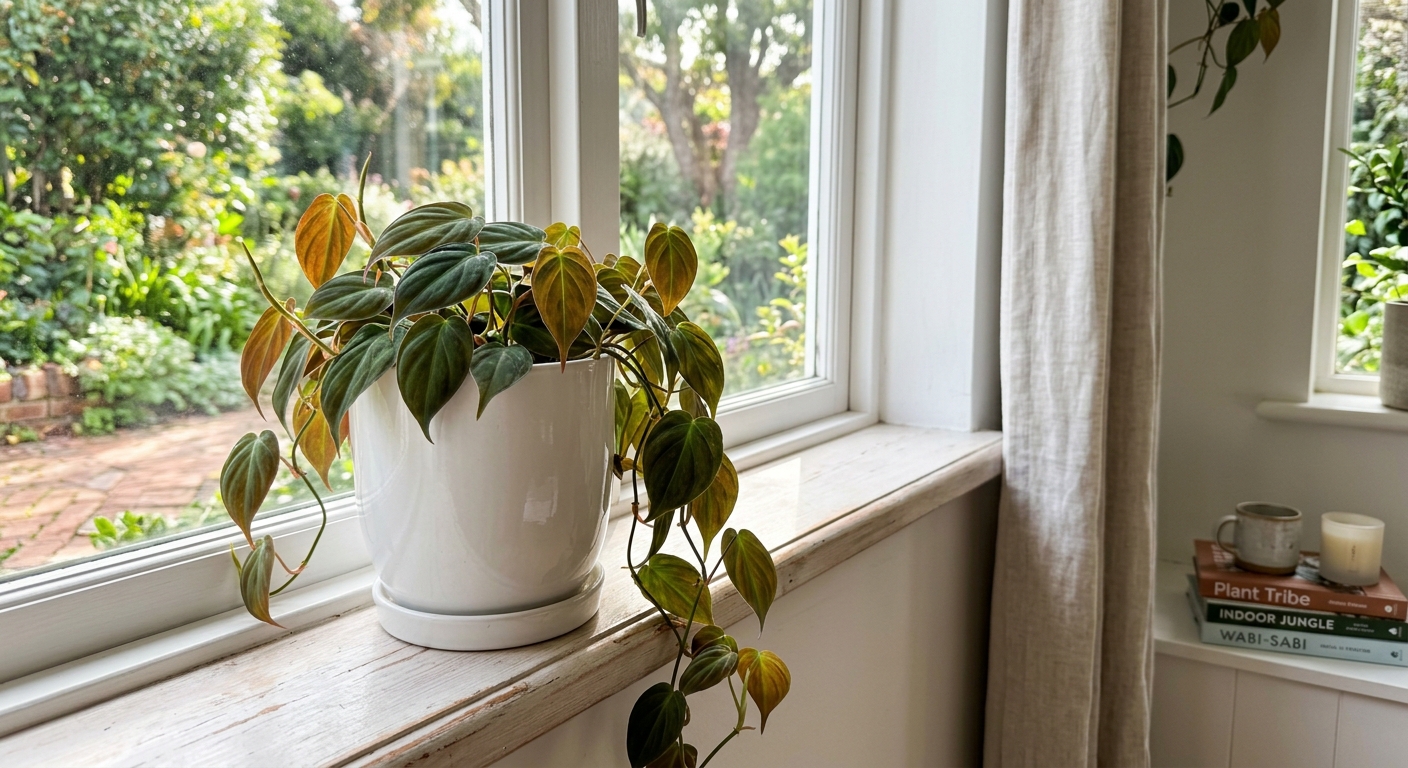
Philodendron Micans is loved for its heart-shaped leaves, soft velvety surface and trailing stems. New leaves often emerge in copper or bronze shades before becoming greener as they mature. The undersides can show reddish or burgundy tones, creating an attractive contrast with the upper surface.
This plant is adaptable to ordinary indoor conditions when it receives enough light, suitable watering and a well-draining potting mix. You can grow it in a hanging basket, let it trail from a shelf or train its stems up a support. Each option gives the plant a different appearance and affects how you manage its growth.
One detail worth understanding is that Micans is sold under a familiar houseplant name, while botanical references place it within the Philodendron hederaceum group. Its foliage can also change as it develops, so a new copper-coloured leaf or an older green leaf does not automatically indicate a care problem.
This guide covers the practical decisions involved in growing Micans indoors, including how to choose between trailing and climbing, when to water, how to encourage fuller growth, and how to recognise common problems.
Philodendron Micans care at a glance
| Care factor | Practical recommendation |
|---|---|
| Light | Bright, indirect or filtered light |
| Water | Allow the upper part of the potting mix to begin drying before watering |
| Soil | Loose, airy and free-draining, with some moisture retention |
| Humidity | Average indoor humidity is usually workable; avoid persistently very dry conditions |
| Temperature | Keep it warm and avoid cold drafts; a general Philodendron guideline is above 15°C (59°F) |
| Growth habit | Trailing or climbing |
| Support | Optional; use a moss pole, trellis or suitable rough support for climbing |
| Fertilizer | Balanced houseplant fertilizer during active growth, following the label |
| Pruning | Trim long or bare stems to manage shape and encourage branching |
| Propagation | Stem cuttings containing at least one healthy node |
What makes Philodendron Micans different?
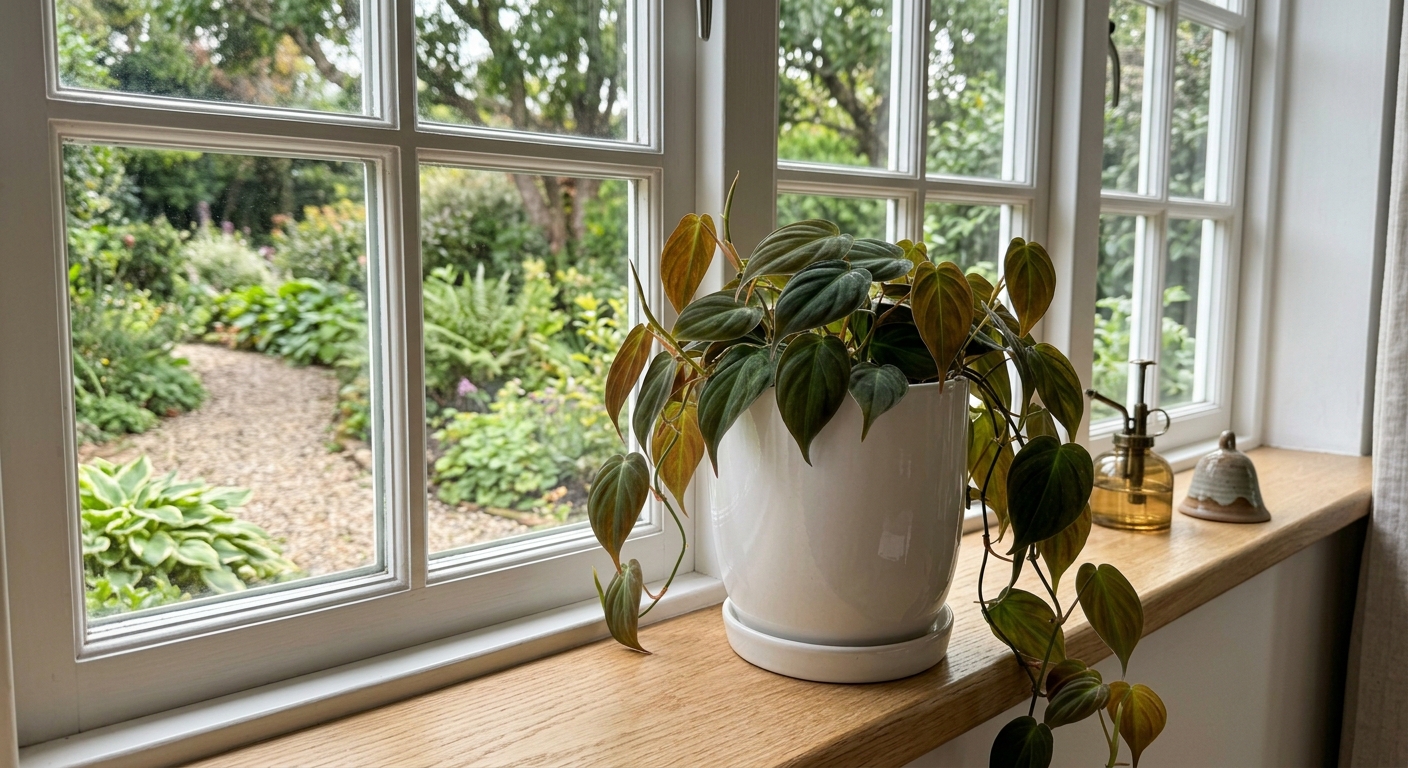
Micans is commonly sold as Velvet Leaf Philodendron or Velvet Philodendron. Its most noticeable feature is the soft, velvety appearance of its heart-shaped leaves.
The upper surface can look bronze, olive green or deeper green, depending on the leaf’s age and growing conditions. The undersides often have reddish or burgundy tones. When light falls across the foliage, the surface can appear to change colour slightly as you view it from different angles.
Micans also has slender, flexible stems that can trail or climb. This makes it suitable for hanging baskets, shelves and vertical supports.
It is important to distinguish the familiar houseplant name from its botanical classification.
Is Philodendron Micans the same as Heartleaf Philodendron?
There is a botanical naming detail worth understanding before comparing care advice.
Kew’s Plants of the World Online treats Philodendron micans as a synonym of Philodendron hederaceum var. hederaceum. The Royal Horticultural Society also lists Philodendron micans among the synonyms of this variety.
In practical terms, Micans is the familiar name used in the houseplant trade for the velvety-leaved form of heartleaf Philodendron. You may also see it listed under Philodendron hederaceum or related names.
This does not mean that every plant sold as a heartleaf Philodendron has the same velvety appearance. The trade name Micans helps distinguish the form that collectors usually want for its soft-looking foliage and bronze-green colours.
When researching its care, information about Philodendron hederaceum is useful because it is the accepted botanical group used in these references. However, not every general description of heartleaf Philodendron will specifically describe the Micans form.
You can check the naming for yourself through Kew’s Plants of the World Online entry for Philodendron micans and the RHS profile for Philodendron hederaceum var. hederaceum.
How Micans leaves change as the plant develops
The colour of new foliage is one of the plant’s most attractive features. A young leaf often emerges in copper, bronze or reddish shades before becoming greener as it develops.
This is normal leaf maturation. It does not mean the plant is losing its colour because it needs more fertilizer or stronger sunlight.
The appearance of Philodendron foliage can also change as plants mature. The Royal Horticultural Society notes that many Philodendrons have different juvenile and adult leaves. However, this general observation should not be turned into a promise that every Micans plant will develop a particular mature leaf shape or lose its velvety surface.
The exact appearance can vary between cultivated plants and growing conditions. Climbing may allow a plant to develop more mature growth, but a moss pole does not guarantee larger leaves or a specific change in texture.
When assessing your Micans, compare leaves at similar stages of development. A newly opened copper leaf will naturally look different from an older, fully developed green leaf.
Decide whether you want Micans to trail or climb
One of the advantages of Micans is that you can grow it in different directions. The choice is mainly about the appearance you prefer and the space available in your home.
Growing Micans in a hanging basket
A hanging basket allows the stems to cascade naturally. It is a practical choice when you want to display the foliage from a shelf, plant stand or ceiling hook.
As the vines extend, they can develop into long hanging strands. Older sections may have fewer leaves than the growing tips, especially when the plant has been growing in insufficient light or has not been pruned for a long time.
For a trailing plant:
- Use a hanging container with drainage holes.
- Give the stems enough room to hang without becoming tangled.
- Rotate the container occasionally if growth leans strongly towards a window.
- Trim damaged or excessively bare sections when needed.
- Keep the plant accessible so you can inspect the undersides of the leaves and check the potting mix.
You do not need a moss pole to grow healthy trailing Micans. Letting the stems hang is a suitable way to grow this plant.
Training Micans to climb
Micans can also grow vertically when given a suitable support. In its climbing habit, Philodendron hederaceum produces stems with aerial roots that can attach to nearby surfaces.
Indoors, you can provide a moss pole, a rough wooden support, a suitable trellis or a bark-covered board.
A support gives the stems somewhere to attach as they grow. It may also help the plant develop a more mature climbing form over time. However, do not assume that every climbing Micans will produce larger leaves or lose its velvety appearance. Those changes are not guaranteed.
To train the plant:
- Position the support securely in the container without damaging the main roots.
- Gently guide an existing vine towards the support.
- Use soft plant ties or clips to hold the stem loosely in place.
- Allow aerial roots to make contact with the support.
- Continue guiding new growth as the plant develops.
A moss pole may be kept lightly moist if you want to encourage aerial roots to attach to it. This is optional, and it does not mean the potting mix should remain wet. A dry trellis or rough support can also be useful for guiding the stems.
Choosing between the two: A hanging basket is convenient when you want cascading vines and do not need the plant to grow vertically. A support is useful when you have space to train the stems upwards and want to manage the plant’s growth in that direction.
Where to place Micans for healthy leaf development
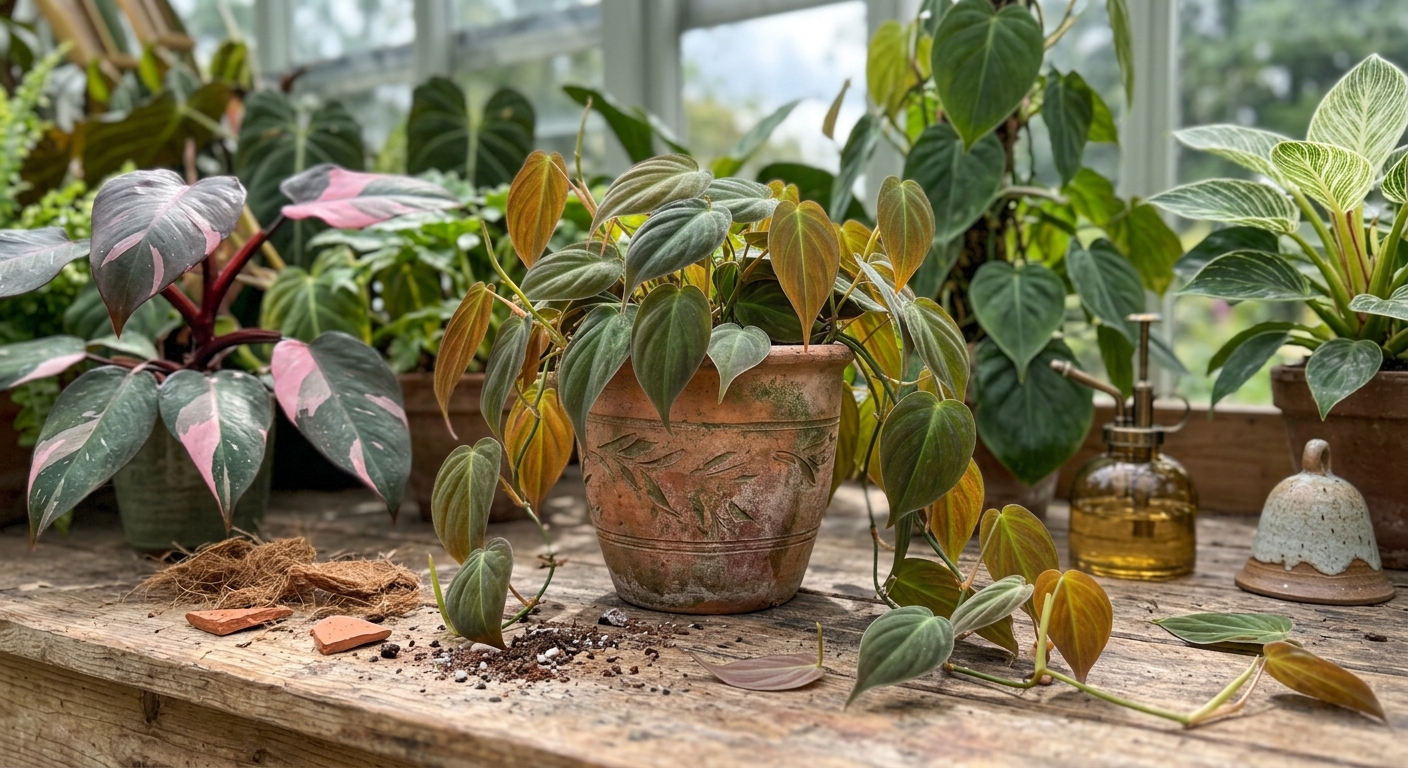
Light has a noticeable effect on how a Micans grows. A plant receiving good natural light is more likely to maintain compact growth than one kept in a dim corner.
Bright, indirect light is the best starting point
Place your plant somewhere that receives plenty of natural daylight without prolonged exposure to harsh direct sunlight.
An east-facing window can be a good location. A bright room with a sheer curtain over a sunny window can also work. Gentle morning sunlight may be tolerated when the plant has adjusted to it, but strong direct afternoon sun can scorch the leaves.
Watch how the plant responds after moving it.
Insufficient light may contribute to:
- Longer gaps between leaves along the stems.
- Smaller new leaves.
- Slower growth.
- Thin, sparse vines.
Too much direct sunlight can cause bleached, faded or crispy patches, particularly on leaves exposed to strong afternoon sun.
If your Micans has been growing in a dim location, move it towards brighter light gradually. Sudden exposure to intense sunlight can damage leaves that have not adjusted to it.
The Royal Horticultural Society’s Philodendron growing guide recommends bright but indirect light and notes that insufficient light can make Philodendrons leggy and reduce leaf size.
Can Micans grow under artificial light?
Yes. A suitable LED grow light can help when your home does not receive enough natural daylight.
Position the light so that it illuminates the leaves without overheating them. Follow the manufacturer’s recommended distance and operating instructions, then watch the plant for signs of stress.
A plant under artificial light still needs suitable watering, airflow and room temperature. A stronger light will not correct a waterlogged root system or a poorly draining potting mix.
Watering: keep the roots moist without keeping them wet
Watering is easier when you understand the difference between a plant that needs moisture and one that has already received too much.
Micans needs moisture for healthy growth, but its roots should not sit in saturated potting mix for long periods. Excess water reduces the air available around the roots and can contribute to root damage.
Instead of following a weekly schedule, check the growing medium before watering.
How to decide when to water
Feel the upper layer of the potting mix. When the top few centimetres have started to dry, check a little deeper to see how much moisture remains around the roots.
You can also use a clean wooden skewer. Insert it carefully into the mix and examine it when removed. If it comes out noticeably damp with wet material clinging to it, the root zone may still contain enough moisture.
Consider these factors:
- Pot size: A large container can hold more water than a small one, especially when the plant has a relatively small root system.
- Growing medium: A chunky mix usually dries differently from dense, fine potting soil.
- Light: A plant receiving more light may use water faster than one in a darker location.
- Temperature: Warm conditions can increase water use, while cooler conditions often slow it down.
- Plant size: A mature Micans with plenty of foliage may use more water than a small cutting.
- Season: Growth and water consumption often slow when daylight and temperatures decrease.
When the mix has reached the appropriate dryness, water thoroughly until excess water escapes through the drainage holes. Empty the saucer or outer pot rather than allowing the container to sit in collected water.
What happens when watering goes wrong?
Underwatering and overwatering can both cause drooping leaves. Check the potting mix before deciding what to do.
| What you notice | What to check |
|---|---|
| Drooping leaves and dry potting mix | The plant may need water. |
| Drooping leaves and constantly wet mix | Check drainage and root health. |
| Several yellowing leaves with wet soil | Persistent excess moisture may be affecting the roots. |
| Dry, crispy leaf edges | Check watering consistency, direct sunlight and indoor conditions. |
| Soft, deteriorating roots | Root damage or rot may be developing. |
Do not assume that every yellow leaf means root rot. An older leaf occasionally yellowing while the rest of the plant continues growing can be part of normal leaf replacement.
For more help distinguishing the symptoms, see Philodendron Overwatering vs. Underwatering.
The potting mix Micans needs
The roots need a growing medium that holds some moisture while allowing excess water to drain away.
Ordinary garden soil is generally unsuitable for this purpose. It can become compacted inside a container, restricting airflow and keeping the root zone wet for too long.
A practical indoor mix can contain:
- Quality indoor potting mix or coco-based substrate for moisture retention.
- Orchid bark for larger particles and improved structure.
- Perlite or pumice to help maintain air spaces and drainage.
You do not need to follow an exact percentage formula. The right balance depends on your growing conditions, container material and how quickly the mix dries.
A warm, bright room may cause the mix to dry faster than a cool, dim location. That does not automatically mean you need a different potting mix. Keep the medium airy and adjust watering according to its actual moisture level.
The important thing is that water can move through the mixture without leaving the roots sitting in soggy material.
The RHS recommends an open, well-drained but moisture-retentive growing medium for Philodendron hederaceum. Its growing guide also explains why drainage matters.
Choosing the right container
Micans does not need an unusually large pot. Choose a container that comfortably accommodates the existing root ball, with a little room for further growth.
Drainage holes are essential.
The container you choose can also depend on how you want to grow the plant.
For a trailing plant: A hanging container is convenient because it allows the stems to cascade. Make sure it has a suitable drainage system and can be reached easily for watering and pruning.
For a climbing plant: A stable container is important because the support and growing stems can make the plant top-heavy. A heavier pot or broad base may help prevent tipping.
Avoid choosing a very large pot simply because the vines are long. The amount of foliage above the soil does not tell you how much room the roots need. Excess potting mix can remain wet for too long when the root system cannot use the available moisture.
Repot when the roots have become crowded, the growing medium has broken down or water management has become difficult. You do not need to repot simply because another growing season has arrived.
When repotting, inspect the roots. Healthy roots should feel firm. Severely damaged roots may be dark, soft or unpleasantly scented. Remove clearly rotten sections with a clean cutting tool and place the remaining healthy roots into fresh, suitable growing medium.
Humidity and temperature without a greenhouse
Micans can grow in ordinary indoor environments when its other needs are met. It does not automatically require a greenhouse or constant misting.
Average indoor humidity is often workable. If your home has very dry air, a humidifier may help maintain more stable conditions. However, brown leaf edges and leaves that struggle to unfurl can also result from inconsistent watering, root problems or physical damage.
Do not assume humidity is responsible without checking these other possibilities.
Regular misting is not a dependable way to maintain room humidity. The moisture disappears quickly, and repeatedly wetting leaves is not a substitute for suitable growing conditions.
Keep Micans in a warm indoor location, away from:
- Cold drafts from frequently opened windows.
- Air-conditioning vents blowing directly onto the leaves.
- Heating equipment that dries the surrounding air.
- Locations exposed to sudden temperature changes.
The RHS recommends keeping Philodendrons above 15°C (59°F). This is a general guideline for the genus, not a temperature requirement established through a specific Micans growing trial. A stable, comfortably warm room is a sensible target.
Feeding Micans without overdoing it
Philodendron Micans benefits from nutrition when it is actively producing new leaves and extending its vines.
A balanced liquid houseplant fertilizer is suitable for routine feeding. Follow the product label for the correct dilution and frequency.
Avoid adding extra fertilizer because the plant appears to be growing slowly. Poor lighting, damaged roots, unsuitable temperatures and an old growing medium can all affect development.
During cooler periods or when growth naturally slows, reduce or pause feeding rather than continuing at the same rate throughout the year.
If you notice crusty mineral deposits on the soil surface or unusual leaf-tip damage following repeated feeding, check whether fertilizer salts are accumulating.
Feeding should support healthy growth, not compensate for poor growing conditions.
Pruning: how to make a sparse Micans look fuller
A Micans plant can develop long vines with noticeable gaps between leaves. This is not necessarily a serious health problem, but it can make the plant look thin.
Pruning helps control its shape and provides material for propagation.
Start by identifying the sections you want to remove. You can trim excessively long vines, damaged stems and sections that have become bare.
When pruning the remaining plant, make a clean cut just above a healthy node. A node is the point on the stem where a leaf, bud or aerial root develops. Keeping a healthy node on the parent stem gives it a point from which new growth may develop.
If you want a fuller hanging basket, do not automatically discard every healthy cutting. You can root suitable cuttings and plant them back into the original container once they have developed enough roots to establish themselves.
Prune selectively rather than removing too much foliage at once. The plant needs healthy leaves to support continued growth.
A period of active growth is generally a suitable time for more substantial pruning. Avoid heavy pruning when the plant is already weak or suffering from root problems.
Propagating Philodendron Micans from stem cuttings
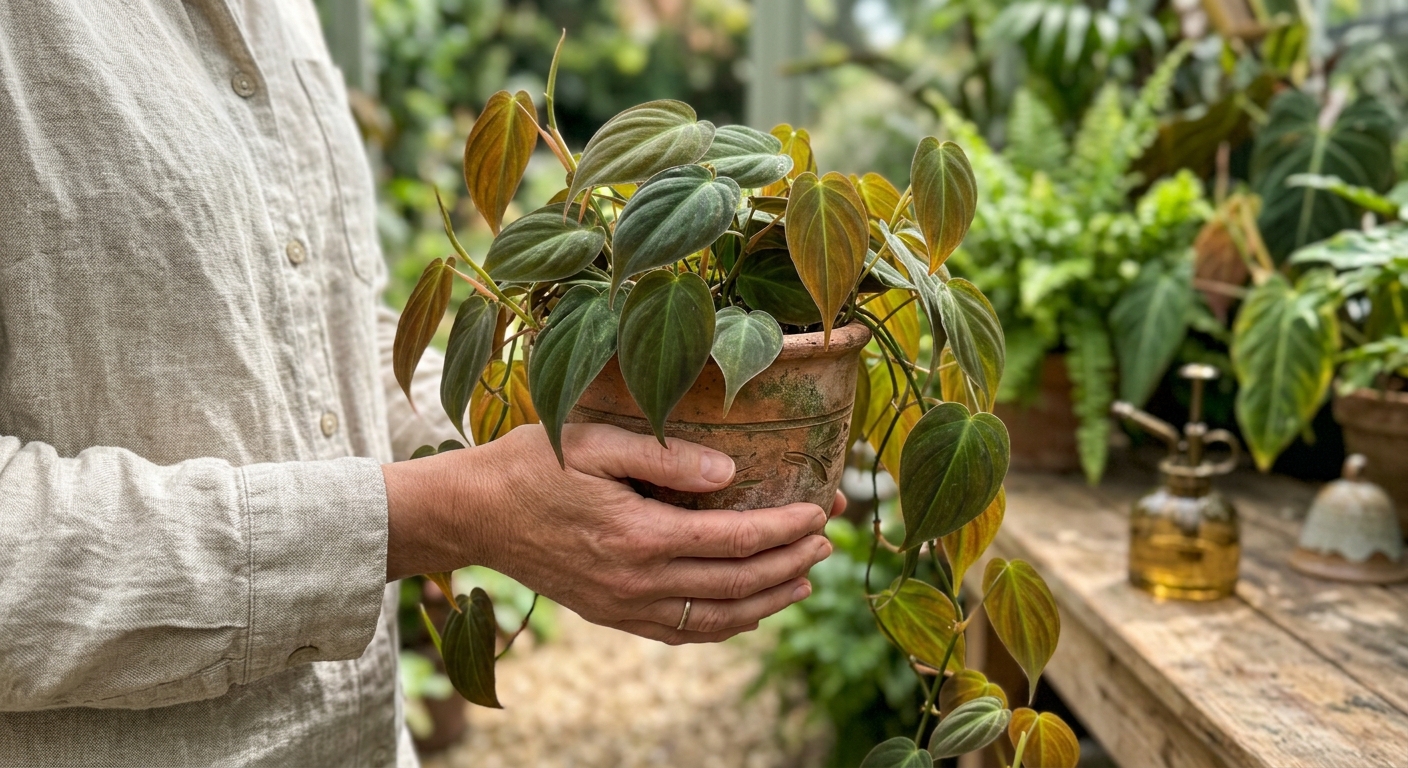
Stem propagation is a practical way to produce new Micans plants. An established vine can provide several suitable cuttings without removing the entire plant from its container.
The important part is choosing a cutting with a healthy node.
Understanding where to cut
Look along a healthy vine for the point where a leaf attaches to the stem. This is the node. You may also see a small aerial root near it.
For a cutting, make your cut just below the node so the node remains attached to the piece you are removing.
A cutting needs at least one viable node to produce roots and continue growing. A detached leaf without a node cannot develop into a new vine.
Whenever possible, choose a cutting with a healthy leaf as well as a node. The leaf can continue photosynthesis while the cutting develops roots.
Use clean, sharp scissors or pruning shears. Avoid taking several cuttings from a small or struggling plant.
Rooting Micans in water
Water is a convenient propagation method because you can observe root development without disturbing the cutting.
- Select a healthy stem containing at least one viable node.
- Cut below the node with a clean tool.
- Remove leaves that would otherwise sit underwater.
- Place the cutting in a clean container, keeping the node submerged.
- Position it in bright, indirect light.
- Check the water regularly and replace it if it becomes cloudy or dirty.
- Allow a healthy root system to develop before potting the cutting into a suitable growing medium.
Keep the leaves above the water while the rooting node remains submerged.
There is no fixed number of days in which every cutting will root. The condition of the cutting, temperature, light and water quality all influence the process.
Rooting Micans in moss or an airy propagation medium
Sphagnum moss, perlite or a suitable propagation mixture can also be used.
Place the node in contact with the lightly moist medium. The goal is to provide enough moisture for root development without leaving the cutting in saturated material.
A clear propagation container can help retain moisture, but monitor it for excessive condensation and poor airflow. Open it periodically when necessary to prevent the medium from becoming excessively wet.
Once the cutting has developed a healthy root system, transfer it carefully into an appropriately sized pot containing your usual growing mix.
Water-rooted cuttings may need some adjustment after moving into a soil-based mixture. Keep the new medium lightly moist while the cutting establishes itself, but do not leave it soaked.
How to make a Micans plant look fuller after propagation
If your original plant has long, sparse vines, healthy rooted cuttings can be planted back into the same container to add more stems.
Do this only when the cuttings have enough roots to establish themselves. Place them around the existing plant without overcrowding the root system.
This approach can make a hanging basket or climbing container look fuller over time. It is usually more useful than repeatedly adding fertilizer in an attempt to force a thin plant to branch.
How to recognise normal leaf changes and growing problems
The leaves are one of the main reasons people grow Micans, so changes in their appearance are often the first thing noticed.
However, not every colour or size change indicates a problem. Consider the age of the leaf, the pattern of damage and the condition of the rest of the plant before changing its care.
| What you notice | What it may mean |
|---|---|
| New leaves emerge copper or bronze | Normal new growth |
| New leaves become greener as they mature | Normal leaf development |
| One older lower leaf gradually turns yellow | Possible normal leaf replacement |
| Several leaves turn yellow in a short period | Check watering, drainage and roots |
| Long gaps between leaves | Insufficient light is one possible cause |
| Dry patches on the window-facing side | Possible sun damage |
| Repeatedly small or weak new leaves | Check light, roots and general growing conditions |
| Silvery marks and distorted new leaves | Inspect for thrips or other pests |
New leaves are copper or bronze
This is generally normal for Micans. New foliage often emerges in warm copper or bronze shades before becoming greener as it develops.
Allow the leaf to open and mature rather than trying to correct its colour with extra fertilizer or stronger sunlight.
Leaves are losing their rich appearance
First, assess the plant’s light conditions. A plant placed too far from a window may produce less compact growth.
However, colour changes also occur naturally as leaves mature. Compare fully developed leaves with other fully developed leaves rather than comparing them with fresh copper-coloured growth.
Existing leaves may not completely change their appearance after a lighting adjustment. Pay more attention to the condition of new growth.
Long vines have very few leaves
This can happen when the plant does not receive enough light for compact growth. However, a trailing plant can also develop long sections as its stems extend.
Check whether newer leaves are becoming smaller, whether the plant receives adequate daylight and whether it has enough support for the growth style you prefer.
Pruning and planting healthy rooted cuttings back into the pot can improve its overall appearance.
Brown or crispy patches are appearing
Look at where the damage occurs.
Patches on the side facing a bright window may indicate excessive direct sunlight. Brown edges across several leaves may have more than one possible cause, including inconsistent watering, dry indoor air or fertilizer salt buildup.
Also consider whether the damage is restricted to older leaves or appearing on new growth.
Make one sensible environmental adjustment at a time instead of changing watering, light and fertilizer simultaneously.
Several leaves are turning yellow
An older leaf occasionally turning yellow while the rest of the plant looks healthy can be part of normal leaf replacement.
Several leaves yellowing over a short period deserve closer attention. Check how wet the growing medium remains, whether the pot drains properly and whether the roots feel firm or damaged.
If the mix is constantly wet and the roots are soft or deteriorating, root damage may be developing. Do not respond to yellow leaves by automatically adding more water or fertilizer.
Pests that can affect Philodendron Micans
Micans can be affected by common indoor plant pests. Its trailing stems and layered foliage provide places for insects to hide.
Inspect the undersides of leaves, stem joints and areas where new growth emerges.
| Pest | Signs to look for |
|---|---|
| Spider mites | Fine webbing, tiny moving specks and pale stippling on leaves |
| Thrips | Silvery scars, damaged or distorted young leaves and sometimes small dark specks |
| Mealybugs | White, cotton-like wax around stems and leaf joints |
| Scale insects | Small, firmly attached bumps on stems or leaf surfaces |
Finding a damaged leaf does not automatically confirm a pest infestation. Examine the plant closely before choosing a treatment.
If you discover insects, isolate the affected plant where practical and inspect nearby houseplants.
Remove visible pests where appropriate, clean affected surfaces and choose a treatment specifically labelled for the identified pest and intended plant use. Follow the product’s instructions, including its application method and repeat-treatment directions.
Avoid assuming that neem oil, rubbing alcohol or household soap mixtures are suitable for every situation. Some treatments can damage foliage, particularly when used incorrectly.
The University of Maryland Extension’s guide to mealybugs on indoor plants explains how to recognise their waxy coverings and manage infestations. Its advice also stresses the importance of isolating affected plants and following treatment directions.
Is Philodendron Micans safe around pets?
No. Micans should be treated as a plant that is harmful if chewed or eaten.
Like other Philodendrons, it contains calcium oxalate crystals. Chewing or swallowing plant material can cause irritation and pain in the mouth and surrounding tissues. Possible signs in pets include drooling, mouth irritation, vomiting and difficulty swallowing.
The sap can also irritate sensitive skin and eyes. Wear gloves when pruning if you are sensitive to plant sap, and wash your hands after handling cut material.
Keep the plant away from children and pets that might chew its leaves or stems.
If a pet eats part of the plant, contact a veterinarian for advice. For suspected human ingestion, seek guidance from a medical professional or local poison service.
North Carolina State Extension provides further information about the toxicity and characteristics of Philodendron hederaceum.
Frequently asked questions about Philodendron Micans
Does Philodendron Micans grow quickly?
It can produce vines steadily under suitable indoor conditions, particularly when it receives enough light, warmth and moisture. Growth varies with the plant’s age, growing environment and seasonal conditions.
Do not judge its health solely by how quickly the vines become longer.
Why are my Philodendron Micans leaves staying small?
Insufficient light is one possibility, especially when the stems also have long gaps between leaves.
The way you grow the plant may also affect how it develops. Climbing can support more mature growth, but it does not guarantee that every new leaf will become larger. Check the plant’s light, roots and general growing conditions before assuming it needs more fertilizer.
Do Micans leaves lose their velvety texture as they mature?
The appearance of Philodendron foliage can change as plants develop, but there is not enough reliable species-specific evidence to say that every Micans plant will lose its velvety texture as it matures.
The plant may show changes in colour, size and surface appearance. These changes should be assessed alongside the overall condition of the plant rather than treated automatically as a care problem.
Can Philodendron Micans live in water permanently?
Stem cuttings can root and begin growing in water. However, rooting a cutting in water and maintaining a mature plant permanently in a water-growing system are different things.
A mature plant grown permanently in water needs a suitable setup and attention to water quality and nutrient availability. Ordinary propagation water should not be treated as a complete long-term growing system.
Should I mist my Micans?
Regular misting is not necessary for healthy growth. It does not provide lasting humidity, and wet foliage is not a substitute for suitable room conditions.
Focus on good light, an appropriate growing medium and consistent watering instead.
Why are my Micans leaves curling?
Curling can happen when the plant is too dry, but it is not a reliable diagnosis on its own.
Check the potting mix first. If it is dry, the plant may need water. If it remains wet, investigate drainage and root health. Also consider temperature changes, direct sunlight and pest damage.
Can Philodendron Micans climb a wall?
You can guide its vines along a suitable trellis or support. Use plant-safe clips or ties and avoid attaching the stems so tightly that they become damaged.
Do not attach the stems directly to a painted wall or a surface that could be damaged by aerial roots or moisture.
How do I make my Micans fuller?
Prune long or bare vines selectively and use healthy node-bearing cuttings for propagation. Once the cuttings have developed enough roots to establish themselves, you can plant them back into the original container.
This adds more stems over time. Also make sure the plant receives adequate light, since low light can contribute to long gaps between leaves.
Final thoughts
Philodendron Micans does not require an elaborate growing setup to develop attractive foliage. Give it bright indirect light, an airy growing medium and watering that responds to how quickly its pot dries.
Decide whether you prefer trailing vines or a climbing plant before arranging its space. A hanging basket works well for cascading growth, while a suitable support gives the stems somewhere to attach as they develop.
Pay attention to new leaves, older foliage and the condition of the roots. Copper-coloured new growth is normal, while repeated yellowing, damaged roots or distorted leaves deserve closer inspection.
With consistent care and enough room for its chosen growth style, Micans can become a healthy, attractive indoor plant.