
Philodendron Micans Care: Growing the Velvet Leaf Philodendron
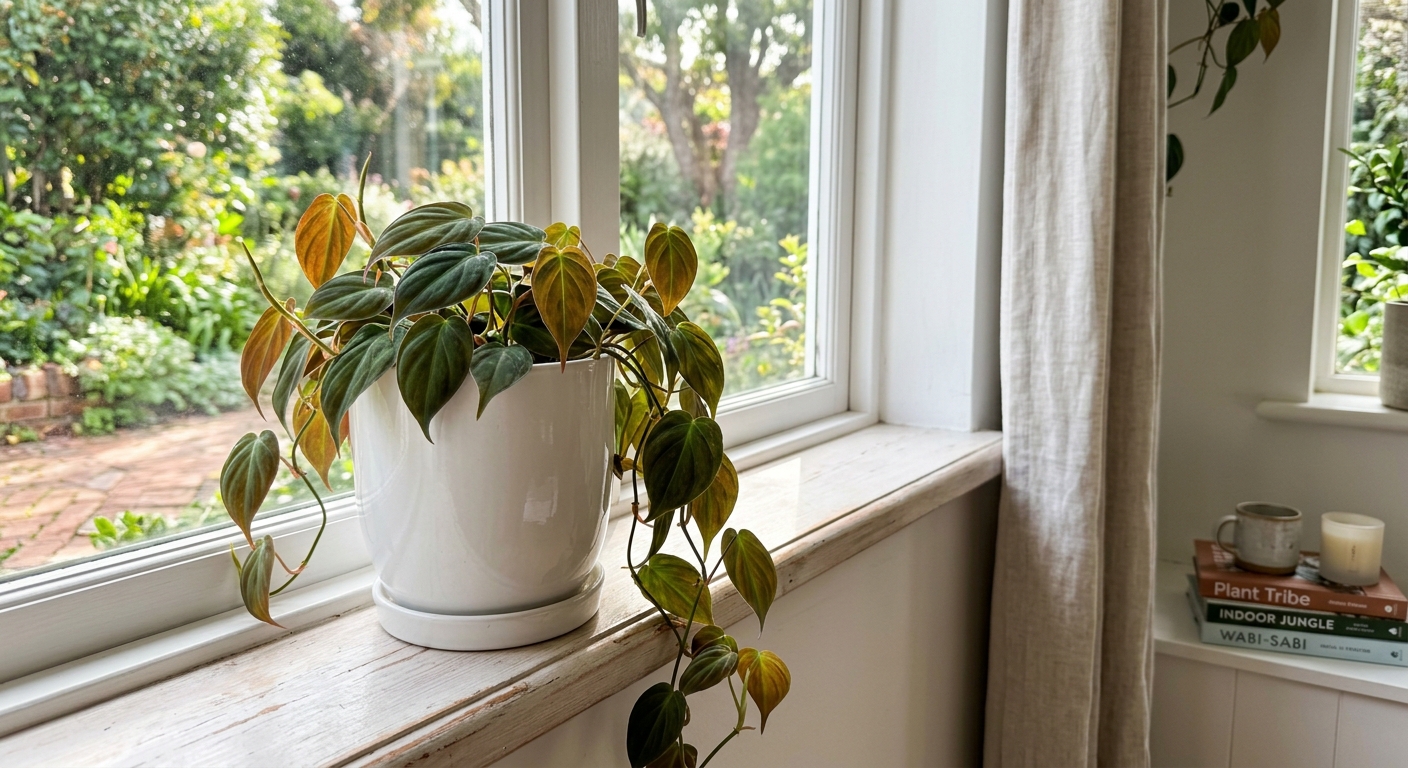
There’s a plant sitting in my collection right now that I genuinely cannot stop touching. It’s the Philodendron micans — also called the velvet leaf philodendron — and if you’ve ever run your fingers across one of its leaves, you already know why it earns that name. The texture is almost impossibly soft, like brushed suede, and the way the leaves shift from deep bronze to emerald green depending on the light is something photographs rarely do justice.
I grew my first micans about six years into my philodendron journey, and it remains one of the plants I recommend most often to anyone building their aroid collection. It’s not just beautiful — it’s genuinely forgiving, fast-growing, and easy to propagate. In eight years of growing philodendrons indoors, I’ve come to appreciate that the best houseplants reward attentive but not obsessive care, and this one fits that description perfectly.
This guide is everything I wish I’d had when I first brought mine home. Whether you’re troubleshooting drooping vines, trying to nail the right soil mix, or planning your first propagation attempt, I’ll walk through every detail — with the kind of nuance that goes well beyond what the typical “water when dry, give indirect light” advice actually offers you.
What Is Philodendron Micans?
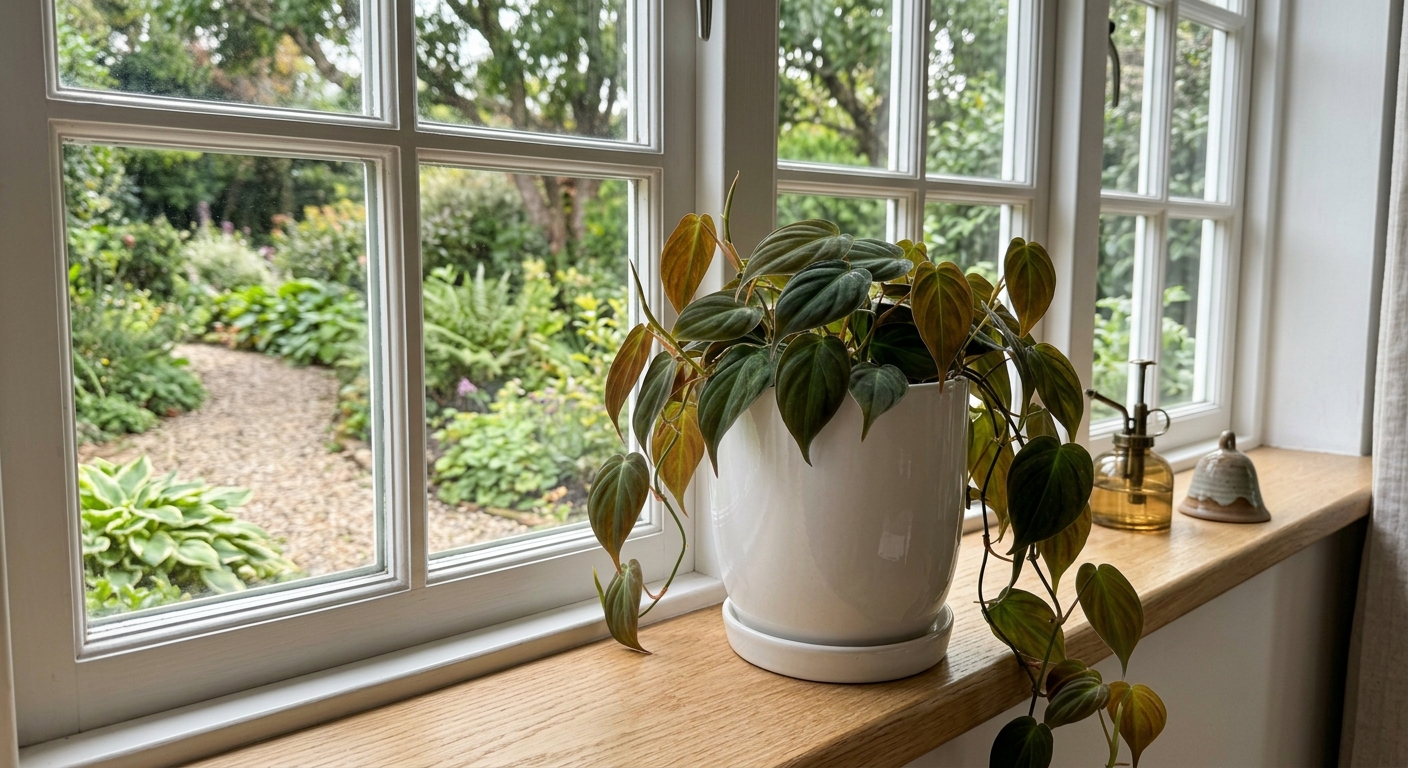
Philodendron micans is a vining tropical houseplant best known for its iridescent, velvety heart-shaped leaves. It belongs to the Araceae family — the same large family that includes monsteras, pothos, peace lilies, and ZZ plants — and shares the climbing, trailing growth habit of other vining philodendrons.
What sets micans apart from its close relatives (like the common heartleaf philodendron) is its unique leaf texture. The fine hairs covering the leaf surface, called trichomes, create that signature velvet feel and also cause the light-catching iridescence that makes this plant look as though it’s glowing under the right conditions. New leaves emerge in a warm copper-bronze, often edged with a soft blush pink, before maturing to a rich dark green with reddish-purple undersides. No two growth stages look quite the same.
It’s also one of the more social-media-famous houseplants of the past several years, and the hype is warranted. The plant is legitimately striking, accessible to beginners, and endlessly rewarding to grow — especially once you get it climbing.
Scientific, Botanical, and Common Names
- Current accepted scientific name: Philodendron hederaceum var. hederaceum Schott
- Previous (trade) name: Philodendron micans K. Koch — now a taxonomic synonym, but still used widely in horticulture and plant retail
- Other synonyms: Philodendron scandens K. Koch & Sello; Philodendron cordatum (in some older literature)
- Family: Araceae (Arum family)
- Genus: Philodendron
Common names include:
- Velvet Leaf Philodendron
- Velvet Philodendron
- Micans Philodendron
- Heartleaf Velvet Philodendron
A quick note on the naming confusion: botanically, “Philodendron micans” is now considered a synonym for Philodendron hederaceum var. hederaceum, per the Wikipedia entry on Philodendron hederaceum. The University of Connecticut’s Home & Garden Education Center confirms this classification in their houseplant literature, noting that “Philodendron micans, which was its previous scientific name, has become its common name. It is correctly known as Philodendron hederaceum var. hederaceum.” (UConn Extension, 2023)
You’ll still see it sold everywhere under “Philodendron micans,” which is perfectly fine — just good to know if you’re comparing care guides or buying online.
Native Origin and Natural Habitat
Philodendron micans is native to the Caribbean and parts of Central America, with its range spanning Mexico, Dominica, Trinidad, Tobago, and surrounding islands. In the wild, it’s found in humid tropical rainforests, where it grows as an epiphyte or hemi-epiphyte — anchoring onto tree trunks with its aerial roots and using the bark’s moisture and nutrients as supplemental resources.
The natural habitat tells you a lot about what this plant needs indoors. Rainforest canopies filter direct sunlight into shifting, dappled light — bright but never harsh. The forest floor maintains consistent warmth and rarely experiences temperature extremes. Humidity is naturally high, though micans has adapted reasonably well to drier indoor conditions over generations in cultivation.
Understanding that this is fundamentally a tree-climber is also key to unlocking its best growth indoors. Given a support to climb, it produces progressively larger leaves. Left to trail freely, it tends to stay compact. More on that in the climbing stake section.
Characteristics and Features
Appearance
- Leaves: Heart-shaped, 2–4 inches long when trailing; can grow considerably larger when climbing. The surface is covered in fine trichomes (tiny hairs) that create the velvety texture. The leaf color shifts with light exposure — in bright indirect light, leaves trend toward rich emerald green with a bronzy iridescence; in lower light, they deepen to a darker, cooler green. The undersides are typically a warm burgundy or reddish-purple.
- New growth: Emerging leaves are a distinctive coppery bronze or chartreuse-bronze, often edged with pink or salmon. This color slowly deepens over a week or two as the leaf hardens off.
- Stems: Slender, wine-red to burgundy stems that complement the leaf undersides.
- Petioles: Long and graceful; leaves hang on long petioles that give the plant an elegant, draped appearance when trailing.
One thing I want to flag for new growers: if you receive a plant that looks more olive or dull green, it likely spent time in lower-light conditions during shipping or at a nursery. Give it a few weeks near a bright window and watch the character come back.
Growth Pattern
Philodendron micans is a fast-growing vining plant with two distinct growth modes depending on how you grow it:
- Trailing mode: Vines hang down from a pot or basket, producing smaller leaves that stay roughly 2–4 inches. This is a great look for shelves and hanging planters.
- Climbing mode: When given a moss pole, trellis, or coco coir totem, the plant activates its epiphytic instinct. It attaches aerial roots to the support and begins producing progressively larger leaves — sometimes 4–6+ inches — with more defined features and richer color. This is where micans really shows off.
In optimal conditions (bright indirect light, good humidity, consistent feeding), you can expect several feet of new growth per year indoors. I’ve had vines reach 4–5 feet in a single growing season under a grow light.
Dormancy
Philodendron micans doesn’t have a true dormancy period the way a deciduous plant does. It remains evergreen year-round. However, growth slows noticeably from late fall through winter, roughly October through February in most US homes, as day length shortens and ambient light intensity drops.
During this slow period:
- New leaves emerge less frequently
- Root growth decelerates significantly
- Water uptake slows (important — this is when overwatering happens most often)
- The plant generally “holds” rather than actively building
Treat winter as a low-activity rest phase rather than true dormancy. Keep it comfortable, water less, skip or reduce fertilizer, and let it coast until spring.
Benefits of Growing Philodendron Micans
Air quality: Like many aroids, philodendrons have been studied for their potential to reduce indoor volatile organic compounds (VOCs). NASA’s Clean Air Study, while limited in scope and scale, included philodendrons among plants showing some VOC-reduction capacity. The study results are documented in peer-reviewed literature, though researchers note that the practical indoor benefit requires significantly more plants than most homes maintain.
Mental health and wellbeing: Multiple peer-reviewed studies have linked indoor plants to measurable reductions in stress and psychological fatigue. A 2019 review published in the International Journal of Environmental Research and Public Health found significant evidence for plants improving mood, attention, and workplace productivity.
Aesthetic versatility: Micans works as a trailing plant in hanging baskets, a climbing feature on a moss pole, a shelf accent, or a window ledge draper. Few plants offer this many display options.
Ease of propagation: A single established plant can give you dozens of new starts over a season with minimal effort or cost — making it one of the most rewarding plants for sharing with friends or expanding your collection.
Beginner-friendly resilience: It tolerates inconsistent watering better than many aroids, bounces back from low light, and signals its stress clearly before it becomes a crisis.
Philodendron Micans Care Guide
Sunlight
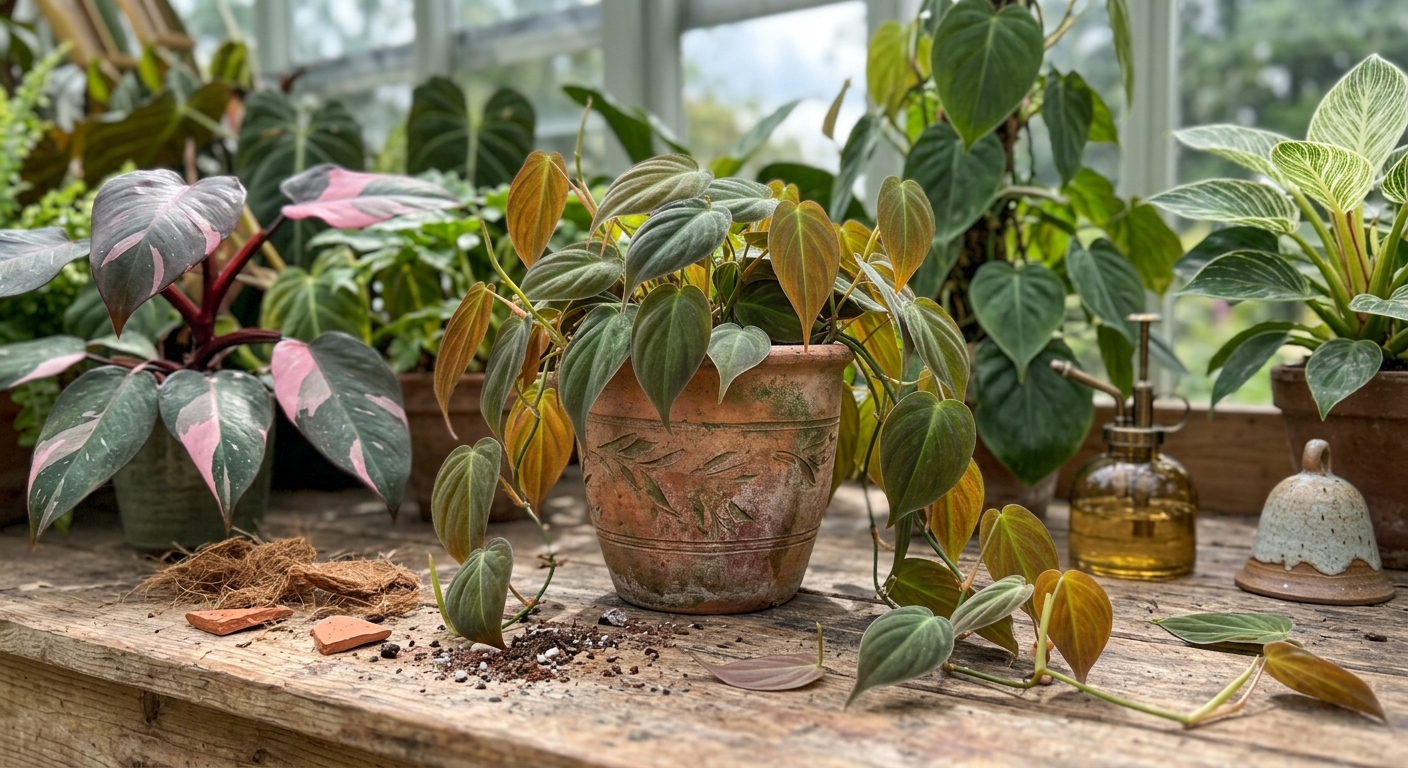
Best light: Bright indirect light, 200–800 foot-candles. Near a north- or east-facing window is often ideal indoors.
What bright indirect light actually means in a typical home: Within 2–5 feet of a window where the sun doesn’t directly hit the leaves for more than an hour or two, especially filtered through a sheer curtain. Think “bright room” rather than “sunbeam on the leaves.”
What happens in lower light: The plant survives and even looks decent, but you’ll notice smaller leaves, longer internodes (the gaps between leaves on the vine), and a loss of that rich color contrast. The copper-bronze of new growth may appear muted. Importantly, lower light means the soil stays wet longer, which increases overwatering risk.
What happens with too much direct sun: The velvety surface is particularly prone to sun scorch. Direct afternoon sun — especially through south- or west-facing windows in summer — will bleach and burn the leaves within days. If you notice pale, crispy patches, move the plant back or add a sheer curtain.
Grow lights: Philodendron micans does excellently under grow lights, which is useful for dimmer homes or apartments. A full-spectrum LED grow light placed 12–18 inches above the plant for 12–14 hours per day will produce excellent results. I use a timer to automate this in my winter setup.
One thing I’ve learned from growing multiple micans in different spots: The plants near my brightest east window consistently produce leaves that are noticeably larger and more vividly iridescent than the one in my home office with lower light. Light is the single biggest lever for color vibrancy in this plant.
Watering
Overwatering is the leading cause of death in philodendron micans, full stop. The roots are relatively fine and delicate, and they do not tolerate sitting in saturated soil.
The general rule: Water when the top 1–2 inches of soil feel dry to the touch. Stick your finger in — if it comes back with any real moisture clinging to it, wait. In most US homes during the growing season, this means watering roughly once a week. In winter, that often extends to every 10–14 days.
A more nuanced approach: Water frequency should follow light. More light = faster soil drying = more frequent watering. Lower light = slower drying = water less often. This is why I recommend adjusting by feel rather than by calendar.
How to water: Water thoroughly — pour until it flows freely from the drainage holes, then let it drain completely. Never let the pot sit in standing water in a saucer for more than 30 minutes.
Signs your micans is thirsty: Leaves will curl slightly inward at the edges and the plant will look slightly less perky. This is the plant’s built-in tell, and it’s a reliable one. The plant author Heather from hometoheather.com notes that “Philodendron micans is such a wonderful plant that it will tell you when it wants water by curling its leaves in slightly.” (hometoheather.com)
Signs of overwatering: Yellow leaves (especially lower/older leaves), soft mushy stems at the base, or a sour smell from the soil. Root rot progresses quickly — if you suspect it, unpot the plant, trim away any black or mushy roots, and repot into fresh dry mix.
Water type: Tap water is generally fine for philodendron micans. If your tap water is heavily chlorinated or fluoridated, letting it sit out overnight before watering can help. I use filtered water during winter when I’m running my humidifier system anyway.
Fertilizers
During the active growing season (roughly March through September), philodendron micans benefits from regular feeding.
What to use: A balanced liquid fertilizer — something with an NPK ratio close to 10-10-10 or 20-20-20 — applied at half the recommended strength is a solid starting point. You can also use a fertilizer with a slightly higher nitrogen (N) ratio to encourage lush foliage growth.
Frequency: Monthly is a safe standard. Some growers go every 2–3 weeks at a more diluted dose. I personally feed my climbing micans every three weeks during summer and see noticeably faster, larger leaf production.
Winter: Reduce or pause fertilizing from October through February. The plant isn’t growing actively enough to utilize the nutrients, and excess fertilizer salts can accumulate in the soil and cause root burn.
Signs of underfeeding: Pale, washed-out leaves (especially newer growth), slow growth, and smaller-than-expected leaf size.
Signs of overfeeding: Crusty white deposits on soil surface, brown leaf tips, or wilting despite adequate moisture (fertilizer salt burn drawing water out of roots).
One tip that’s made a difference for me: Always water the plant before fertilizing, never apply fertilizer to completely dry soil. It’s one of the easiest ways to prevent root burn.
Soil Mix
Philodendron micans needs a well-draining, chunky, aerated mix. Standard potting soil out of the bag is generally too dense and moisture-retentive — it’ll stay wet too long, especially in lower-light homes.
My preferred aroid mix for micans:
- 40% quality potting mix (I use something like Fox Farm Happy Frog)
- 30% perlite
- 20% orchid bark (fine to medium grade)
- 10% worm castings
This produces a fast-draining mix that still holds enough moisture and nutrition for healthy growth. The orchid bark adds structure and the perlite prevents compaction.
Commercial options: Premixed aroid soils are increasingly available from specialty plant suppliers online. They’re a solid option if you prefer not to DIY your mix.
What to avoid: Mixes with heavy peat alone (compacts and dries hydrophobically), garden soil (too dense, may harbor pathogens), and anything that stays wet longer than a few days.
Humidity
In its native Caribbean habitat, philodendron micans grows in conditions where relative humidity often exceeds 70–80%. Indoors, most US homes sit around 30–50% relative humidity — below ideal, but workable.
Minimum comfortable range: 40–50% RH. The plant will survive lower, but you may see brown leaf tips and slower, smaller growth.
Ideal range: 60%+. At higher humidity, you’ll notice richer leaf color, more prominent iridescence, and noticeably larger leaf production — especially on climbing specimens.
How to boost humidity:
- Humidifier: The most effective and consistent method. A cool-mist or ultrasonic humidifier near your plant cluster works well.
- Pebble tray: Fill a saucer with pebbles and water; place the pot on top (above the water line). Evaporation provides localized humidity.
- Plant grouping: Plants transpire water vapor, so grouping your micans with other tropicals raises ambient humidity around the cluster.
- Misting: Many sources recommend misting, but I’d caution against it as a primary humidity strategy. It raises humidity very briefly and can invite fungal issues if water sits on the velvety leaves.
Temperature
Philodendron micans is a tropical plant and doesn’t appreciate cold.
Comfortable indoor range: 65–85°F (18–29°C). This covers most US home temperatures year-round.
Minimum safe temperature: 55°F (13°C). Below this, growth stalls and cold damage becomes a real risk.
What to watch for: Cold drafts near air conditioning vents, drafty windows in winter, and windowsills that get genuinely cold overnight. The leaves will develop cold spots (darkened, water-soaked patches) if exposed to cold for extended periods.
Never place micans: Near air conditioning vents blowing cold air directly at the plant, outside in temperatures below 55°F, or on an unheated porch or sunroom in fall and winter.
Climbing Stake
This is one of the most underutilized care tips for micans, and it makes a dramatic difference.
When given a moss pole, coco coir totem, or wooden trellis to climb, philodendron micans activates its natural epiphytic climbing behavior. It grabs onto the support with aerial roots and begins producing progressively larger leaves as it climbs — sometimes two to three times the size of what you’d get in trailing mode. The growth also tends to be denser and more vigorous.
One TikTok plant creator who’s grown micans extensively describes the transformation: “It started as a one leaf cutting that I potted up with this trellis, and now a few years later, it’s grown to be so full that you can’t even see the trellis in the center! I love the leaves and it’s so cool to see how the plant has grown from tiny leaves to growing bigger leaves since it has support!” (TikTok @plantsoftiktok via tiktok.com)
How to encourage attachment: Keep the moss pole or coco coir totem consistently moist, especially at the base. Use clips, plant tape, or bendable wire to guide new vines toward the support until they attach naturally.
Trellis vs. moss pole: Both work. Moss poles stay moist and encourage more robust aerial root attachment (the roots can actually penetrate the moss). Wooden trellises and metal grids work well aesthetically and are easier to swap in and out.
Toxicity
Philodendron micans is toxic to humans, cats, and dogs. Like all members of the Araceae family, it contains calcium oxalate crystals — microscopic, needle-like structures that cause intense irritation when chewed or ingested.
Symptoms in pets: Oral pain, drooling, pawing at mouth, vomiting, difficulty swallowing. In rare severe cases, airway swelling can occur.
In humans: The same burning and irritation in the mouth and throat. Not typically life-threatening, but extremely unpleasant.
ASPCA classification: Philodendrons are listed as toxic to cats and dogs by the ASPCA. If you have curious pets, keep micans in hanging baskets or on high shelves beyond their reach.
If ingestion occurs: Rinse mouth with water and contact poison control or your veterinarian. For pets in the US: ASPCA Animal Poison Control Center at (888) 426-4435.
Philodendron Micans Repotting Guide
Repot your philodendron micans when you notice one of these signals:
- Roots visibly circling the bottom of the pot or pushing through drainage holes
- Water runs straight through without being absorbed
- Growth has slowed significantly despite good light and feeding (in season)
- You can see roots crowding the soil surface
Timing: Spring is ideal — the plant is entering its active growth phase and will recover and establish quickly. Avoid repotting in winter when the plant’s metabolism is slower.
Pot size: Go up just 1–2 inches in pot diameter (e.g., from a 4″ to a 6″ pot, or from a 6″ to an 8″ pot). This is important. An oversized pot holds far more soil than the roots can use, which means the unused soil stays wet and creates root rot risk.
Pot material: Terra cotta dries out faster than plastic or ceramic — useful for growers who tend to overwater, but requires more frequent watering in dry climates or with grow lights. I use terra cotta for most of my micans.
Step-by-step repotting:
- Water the plant a day before to make unpotting easier and reduce root stress.
- Gently tip the plant out of its pot, loosening the sides if needed.
- Inspect roots — trim away any black, mushy, or foul-smelling roots with clean scissors.
- Add fresh aroid mix to the bottom of the new pot.
- Center the plant, backfill with mix, and press lightly to remove air pockets.
- Water thoroughly and place the plant in its usual spot.
- Hold off on fertilizing for 4–6 weeks to give disturbed roots time to settle.
Philodendron Micans Pruning Guide
Micans vines grow fast, and without occasional pruning, they’ll get long and leggy — beautiful in a cascading way, but sometimes sparse and less full than you want.
Why prune:
- To maintain a compact, bushy shape
- To remove damaged, yellowed, or diseased leaves
- To encourage branching (cutting a vine stimulates dormant nodes below the cut to activate)
- To harvest cuttings for propagation
How to prune: Use clean, sharp scissors or pruning shears. Cut just above a node (the bump on the stem where a leaf or aerial root emerges). This leaves the node intact and ready to produce a new shoot.
When to prune: Anytime during the growing season is fine. I’d avoid major cuts in mid-winter when the plant’s recovery capacity is reduced.
What to do with cuttings: Propagate them (see below) — don’t waste healthy stem material.
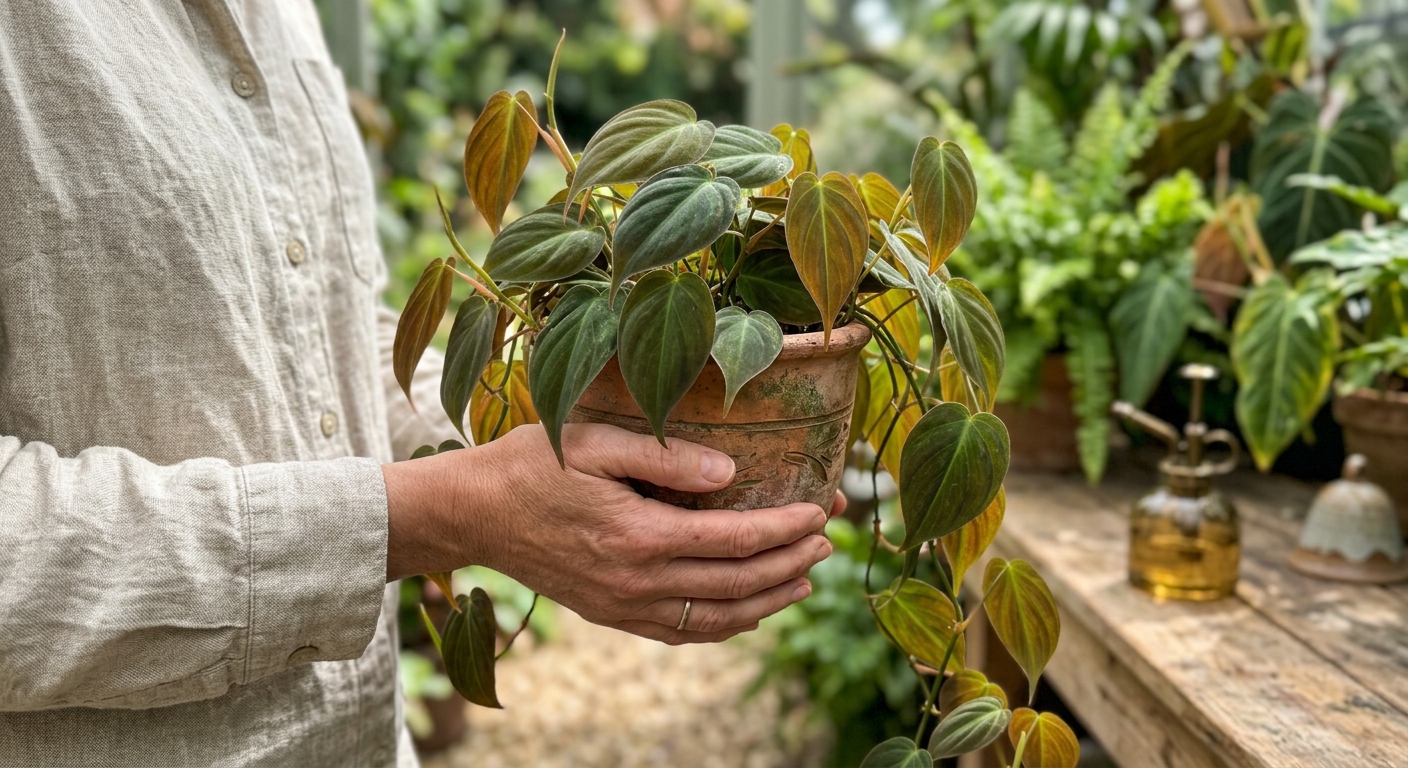
An important note on leaf cleaning: Because micans has velvety leaves, they can accumulate dust that blocks photosynthesis. Instead of wiping (which can damage the trichomes), blow gently with a bulb duster or use a very soft brush. Never spray and wipe like you would a glossy-leaved plant.
Philodendron Micans Propagation Guide
This is one of the most rewarding aspects of growing micans — propagating from stem cuttings is genuinely easy, and success rates are high.
What you need: A healthy vine with at least one node, clean scissors, and either a glass of water or a moist propagation medium (perlite, sphagnum moss, or a perlite/coco coir mix).
Step-by-step water propagation:
- Select a healthy vine section with 1–3 nodes and at least one leaf.
- Cut just below the lowest node with clean scissors.
- Remove any leaves that would sit below the water surface.
- Place the cutting in a clear glass or jar of water, ensuring the node(s) are submerged.
- Place in bright indirect light.
- Change the water every 4–7 days to keep it oxygenated and clear.
- After 2–4 weeks, you should see white roots emerging from the nodes.
- Transfer to soil when roots are 1–2 inches long.
Step-by-step soil/sphagnum moss propagation:
- Take a cutting with 1–3 nodes as above.
- Let the cut end callous for an hour.
- Stick into moist sphagnum moss or a perlite mix, ensuring the node is in contact with the medium.
- Enclose in a clear plastic bag or prop box to maintain high humidity.
- Place in bright indirect light — avoid direct sun as heat buildup under plastic can cook the cutting.
- Check after 3–4 weeks for root resistance when gently tugged.
- Once rooted, acclimate slowly to ambient conditions before treating as a mature plant.
Tips from experience: Sphagnum moss produces thick, healthy roots faster than water in my experience, but water is more beginner-friendly because you can actually see what’s happening. Node-only propagations (no leaf) are possible but take longer — include a leaf if you can.
Common Pests and Diseases: Problems and Solutions
Pests
Thrips — This is the most important pest warning for micans specifically. As noted by the experienced grower at ourhouseplants.com: “The Micans is resistant to many pests or rather, they’re not attractive to them. But Thrips are the exception to this rule. If they find your plant and take a fancy to it, they will start to devastate it within a few weeks.” Thrip damage appears as silvery streaking, stippling, or distorted new growth. Look for tiny, fast-moving insects (about 1mm) on and under leaves.
Treatment: Spinosad-based insecticides or neem oil, applied weekly for 4–6 weeks. Isolate the plant immediately to prevent spread to other aroids.
Spider mites — Common during dry winter months with low humidity. Look for fine webbing on leaf undersides and tiny moving specks. Leaves may look bronze or silvery.
Treatment: Shower the plant thoroughly to wash off mites. Follow with neem oil or insecticidal soap, repeating every 5–7 days for 3–4 weeks. Raising humidity helps prevent recurrence.
Mealybugs — White, cottony clusters in leaf axils and along stems.
Treatment: Dab individual mealybugs with a cotton swab dipped in 70% isopropyl alcohol. Follow with neem oil or insecticidal soap treatment. Check neighboring plants.
Fungus gnats — More of a nuisance than a serious threat to mature plants, but larvae can damage fine roots. Associated with overwatering and staying wet too long.
Treatment: Allow soil to dry more between waterings. Apply a layer of coarse perlite or sand on top of the soil to discourage egg-laying. Sticky yellow traps catch adults.
Diseases
Root rot — The most common disease issue, caused by overwatering and/or poor drainage. Symptoms include mushy black roots, yellowing lower leaves, and a sour smell from the potting mix.
Treatment: Unpot the plant, trim away all affected roots, allow roots to dry briefly, and repot in fresh well-draining mix. Adjust your watering practices going forward.
Bacterial leaf spot — Brown, water-soaked spots on leaves that spread if unchecked. Often associated with splashing water on leaves or poor air circulation.
Treatment: Remove affected leaves, improve air circulation, and avoid getting leaves wet when watering. Copper-based bactericides can help in persistent cases.
Pythium/Phytophthora — Fungal root rot issues that can occur in overly wet, compacted soils.
Prevention is far better than treatment: Well-draining mix, proper watering intervals, and pots with drainage holes are your best defenses.
Philodendron Micans Pricing Guide
The price of philodendron micans has shifted considerably over the past few years as it moved from specialty plant shops to mainstream retail. It’s now widely available and very affordable for most sizes.
| Size/Type | Price Range (US) | Where Available |
|---|---|---|
| Small starter / 2″ pot | $6–$15 | Etsy, specialty growers, eBay |
| 4″ grower pot | $15–$40 | Home Depot, Walmart, local nurseries, online |
| 6″ grower pot | $40–$60 | Home Depot, Walmart, online retailers |
| Hanging basket (4″) | $45–$55 | Walmart, specialty growers |
| Established trailing/climbing plant | $50–$100+ | Specialty plant shops, Etsy |
| Variegated (‘Aurea’) | $100–$500+ | Specialty/rare plant sellers |
For reference, Home Depot currently lists a 4″ micans at $25.99 and a 6″ specimen at $57.56. Walmart’s online marketplace offers 4″ pots starting around $31–$40 from third-party sellers.
Your best value for healthy, established plants is usually a local independent nursery or a reputable Etsy seller with strong reviews. Specialty online sellers like Logee’s Plants also reliably stock micans with good quality guarantees.
Buying Guide for Philodendron Micans
Knowing where and how to buy a healthy micans makes a real difference in how smoothly the transition to your home goes.
What to look for when buying in person:
- Leaves with vibrant color and that signature velvety texture (run your finger across a leaf — it should feel soft and slightly fuzzy)
- Firm, upright stems with no mushy spots
- No visible pests — check leaf undersides and stem axils carefully
- New growth (cataphylls) present, which indicates an actively growing plant
- Soil that doesn’t smell sour or swampy
Red flags:
- Yellow or brown leaves beyond minor cosmetic damage
- Leggy, sparse vines with large gaps between leaves (sign of low-light nursery conditions — can be corrected, but expect a slower start)
- Tiny black flies around the soil (fungus gnats — annoying to deal with)
- White powdery residue or webbing on leaves (pests)
- Pot with no drainage holes
Buying online:
- Check seller reviews and look specifically for mentions of shipping quality and plant health on arrival
- Look for sellers who ship in insulated packaging or offer live arrival guarantees
- Order in spring or fall when temperature extremes are less severe — summer heat and winter cold can both stress plants during shipping
Where to buy:
- Local nurseries and independent plant shops — Best for inspecting in person
- Home Depot / Lowe’s — Widely available; quality varies; check individual plants carefully
- Etsy — Huge range of sellers and sizes; read reviews carefully; good for rooted cuttings if you want to save money
- Facebook Marketplace / local plant groups — Excellent source for well-established plants, often at low prices, from fellow hobbyists
Common Mistakes to Avoid
1. Overwatering in winter. This is the single most common error. Growth slows, water uptake slows, and plants sitting in wet soil for extended periods develop root rot. In fall and winter, cut watering frequency significantly.
2. Using soil that retains too much moisture. Standard potting soil is often too dense for micans. Amend with perlite and orchid bark, or use a premixed aroid blend.
3. Pot too large for the plant. Oversized pots = oversized soil volume = too much moisture held for too long. Repot conservatively.
4. Direct sunlight on velvety leaves. The trichomes that create the velvet texture are delicate. Even a few hours of direct afternoon sun can bleach and scorch them quickly.
5. Ignoring thrips. Because micans is relatively pest-resistant overall, some growers get complacent. Thrips can establish quickly on this plant and are genuinely destructive. Check undersides of leaves monthly.
6. Not giving it something to climb. Most people trail their micans when it would produce significantly larger, more impressive leaves on a support. Even a simple trellis makes a noticeable difference.
7. Misting leaves as the primary humidity strategy. Fine droplets sitting in the velvet texture can promote fungal issues. Use a humidifier or pebble tray instead.
8. Fertilizing in winter. Unused fertilizer accumulates as salt in the soil and can cause root burn. Hold off from October through February.
9. Confusing micans with Philodendron melanochrysum. These two look remarkably similar, especially as juveniles. Melanochrysum leaves tend to be darker, larger, and have more defined vein contrast. If you’re buying online, confirm the plant with photos before purchasing.
10. Propagating without checking for nodes. A cutting with no node will not root. Always confirm you have at least one node in your cutting before propagating.
Social Proof: What Other Growers Are Saying
Plant lovers around the world have fallen hard for this one. A customer on Happy Houseplants wrote simply: “I stare at it everyday. SO pretty, the leaves on micans is something else 🤍” (happyhouseplants.co.uk)
TikTok plant creator Reena (@reenasplants), who documents her collection in detail, describes micans care in very similar terms to what I’ve shared here: “This plant is one of my favorite unique but low maintenance plants in my collection. It has dark green velvety leaves which turn slightly redder the more sun they get.” (tiktok.com/@reenasplants)
And on the climbing benefit specifically, one TikTok creator’s before-and-after growth story says it better than any care chart could: “It started as a one leaf cutting that I potted up with this trellis, and now a few years later, it’s grown to be so full that you can’t even see the trellis in the center! I love the leaves and it’s so cool to see how the plant has grown from tiny leaves to growing bigger leaves since it has support!” (tiktok.com/discover/philodendron-micans-trellis)
One more worth noting: the Royal Horticultural Society awarded philodendron micans its coveted Award of Garden Merit in 1993 — a recognition given to plants of outstanding quality for garden or indoor use, as noted by Gardener’s Path. That’s over three decades of formal acknowledgment of what plant enthusiasts have known for years.
Frequently Asked Questions (FAQ)
Q: Is philodendron micans the same as heartleaf philodendron? A: They’re very closely related — both are varieties of Philodendron hederaceum — but not quite the same. The standard heartleaf philodendron (P. hederaceum var. oxycardium) has smooth, glossy green leaves. Micans (P. hederaceum var. hederaceum) has the velvety texture, iridescent finish, and reddish-purple undersides. Botanically siblings; aesthetically distinct.
Q: Why are my philodendron micans leaves so small? A: Most commonly, insufficient light. Low light produces small leaves with long internodes (leggy vines). Move the plant closer to a bright window or add a grow light. Also: if it’s a trailing plant, give it something to climb — climbing produces noticeably larger leaves than trailing.
Q: Can philodendron micans grow in low light? A: It can survive in lower light, and it’s more tolerant than many aroids in this regard. But growth will slow, leaves will be smaller, and the rich color and iridescence will fade. “Tolerates low light” doesn’t mean it thrives there — bright indirect light is genuinely better.
Q: Why are my micans leaves turning yellow? A: Most often overwatering. Yellow leaves — especially starting with lower or older leaves — combined with wet soil is a classic overwatering pattern. Let the soil dry out more between waterings. Other causes: too little light, fertilizer deficiency (in the growing season), or occasionally root bound stress.
Q: How fast does philodendron micans grow? A: In good conditions (bright indirect light, consistent warmth, regular fertilization, good humidity), it’s a vigorous grower — easily several feet of new vine per year. In lower light with no feeding, growth is noticeably slower. It picks up significantly after spring arrives.
Q: Can I grow philodendron micans in water long-term? A: Many growers do keep micans in water indefinitely (hydroponics/LECA). Roots adapt to water over time. You’ll need to supplement with a diluted water-soluble fertilizer, as plain water provides no nutrition. It’s a viable alternative if you struggle with soil moisture management.
Q: What’s the difference between micans and melanochrysum? A: As juveniles, they’re very similar. Melanochrysum (also called the black gold philodendron) has darker, more velvety leaves with more pronounced pale vein contrast, and grows considerably larger at maturity. Micans stays comparatively compact. If you’re unsure which you have, melanochrysum leaves tend to feel heavier and more substantial to the touch.
Q: Is there a variegated philodendron micans? A: Yes — Philodendron micans ‘Aurea’ exists, with yellow-variegated leaves, and there’s also a halo variety with white marginal variegation. Both are significantly rarer and more expensive than the standard form, often trading for $100–$500+ depending on the quality and size of the variegation.
Q: How do I make my micans bushier? A: Prune long vines back to just above a node. This stimulates dormant nodes below the cut to produce new shoots, creating a fuller, more branching plant. Regularly “pinching” new growth tips also encourages lateral branching over time.
Q: Can I let philodendron micans climb my wall? A: Yes, and many growers do. You can use command strips, plant hooks, or small clips to guide vines along walls. The aerial roots will eventually try to attach to porous surfaces. Some growers install a strip of cork board or moss mat along the wall to give the roots something to grip. Gorgeous when done well, but understand the plant will eventually attach and may leave marks if removed.
Conclusion
After eight years of growing philodendrons — from the humblest heartleaf varieties to rare aroids that take months to produce a single new leaf — the Philodendron micans remains one of my most consistently recommended plants. It earns that recommendation for a simple reason: it’s genuinely beautiful, genuinely low-maintenance, and genuinely rewarding to grow.
The key insights I’d leave you with:
Give it enough light to keep the color vibrant. Water less than you think you need to — the velvet leaves are forgiving, but the roots aren’t. Get it a moss pole or trellis if you want to see what it can really do. And when you inevitably want more of it (you will), just take a cutting and drop it in water. You’ll have a new plant rooting within three weeks.
If you found this guide useful, check out our other detailed care guides at jefrev.com, including our deep dives on Philodendron hederaceum varieties, our complete aroid soil mix guide, and how to set up a moss pole for climbing aroids.
Questions or something I missed? Drop a comment below — I read everything, and this guide gets updated as I learn.